Table of Contents
- Real hide or engineered sheet
- The pattern is the product
- Lining, interlining and how the jacket holds shape
- Hardware that survives a season
- Colour, light and how leather fades
- Closing notes and further reading
Nobody hands a custom leather jacket brief to a pattern cutter and says: the leather is the pattern. They should. A hide stretches across the grain and not along it, it has a belly that is looser than the back, and it carries scars that must be cut around or cut into the design. The pattern has to know which direction the grain runs, where the stretch lives, and how much of the hide is usable. Get that wrong and every panel after the first one drifts.
Real hide or engineered sheet
Buyers who have not handled both tend to brief genuine leather and PU synthetic leather the same way, but they are not the same material. A hide breathes and takes a patina, and it stretches about 4 to 6 percent across the grain under moderate tension without returning evenly. PU does none of that. It is dimensionally stable, cuttable in bulk from a roll, and its finish stays consistent across the whole order. Both are legitimate for a jacket range. Briefing them as interchangeable is not.
If the specification says PU, the thickness matters before anything else. Suppliers commonly list PU for outerwear between 0.8 mm and 1.4 mm total thickness. The lower end gives you a jacket that drapes like cloth and creases at the elbow. The upper end gives you a structured, boxy silhouette that holds its shape on a hanger. A first range at about 1.2 mm is the safe call. It holds a collar yet stays thin enough that the front placket does not become a wall of material.
The coating deserves a line on the spec too. ASTM D751 is the standard set of test methods for coated fabrics, covering breaking strength, tear resistance, coating adhesion and abrasion. Coating adhesion is the one that matters most for a jacket, because a PU that delaminates at the elbow or collar is a jacket that comes back. Ask the supplier for the adhesion test result on the actual batch, not on a generic data sheet.
The pattern is the product
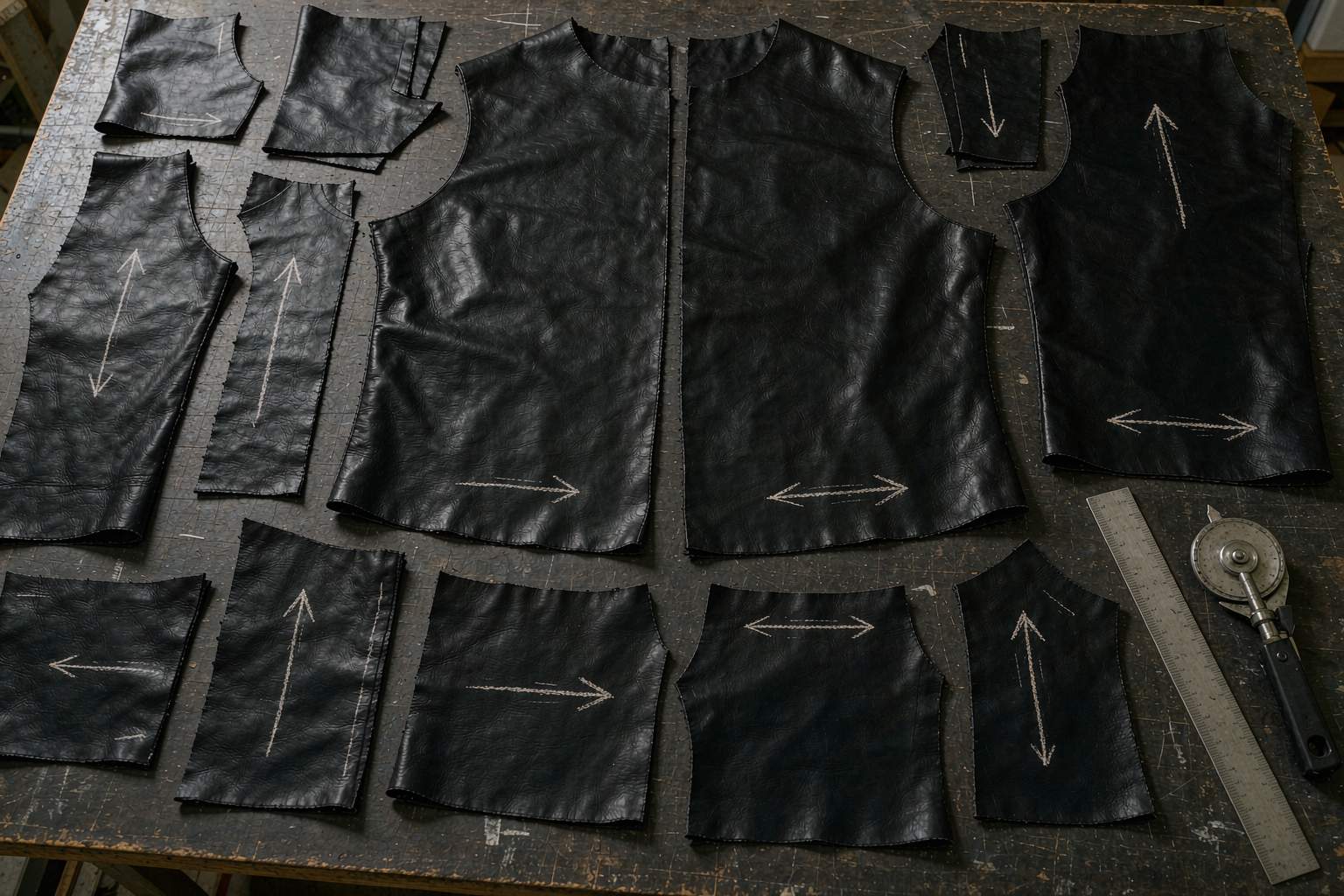
A leather jacket pattern is cut differently from a fabric jacket pattern. The grain direction is marked on every panel. The pattern pieces are nested to avoid the loose belly and the neck creases of the hide. The cutter works from a hide map, not from a marker laid straight on a roll.
That means the pattern cutter needs to know the hide size. A standard steer hide runs about 45 to 50 square feet, and the usable area after cutting around defects is typically 70 to 80 percent of that. Ask the factory how many jackets they get from one hide. The answer tells you whether the pattern was nested for yield or for appearance, and those two goals fight each other.
If the jacket is PU, the pattern is simpler. PU comes in a roll, and the nesting works like fabric. The grain direction still matters for stretch consistency, but there are no scars to avoid.
- Ask for the grain direction to be marked on every pattern piece. If it is not on the pattern, it is not on the cutter’s mind.
- Check the collar pattern against the shoulder seam. A collar cut on the cross-grain stretches differently from one cut on the straight grain, and the collar points will sit at different heights.
- Put the seam allowance in writing. Leather does not fray, so the allowance can be smaller than on woven fabric, but it still needs to be consistent.
Lining, interlining and how the jacket holds shape
A leather jacket without an interlining collapses. The hide is the shell. The body comes from what is fused or sewn inside it. A light fusible interlining at the collar and the front placket is what keeps a jacket looking structured after a month on a rail. Without it, the collar droops and the front opening waves.
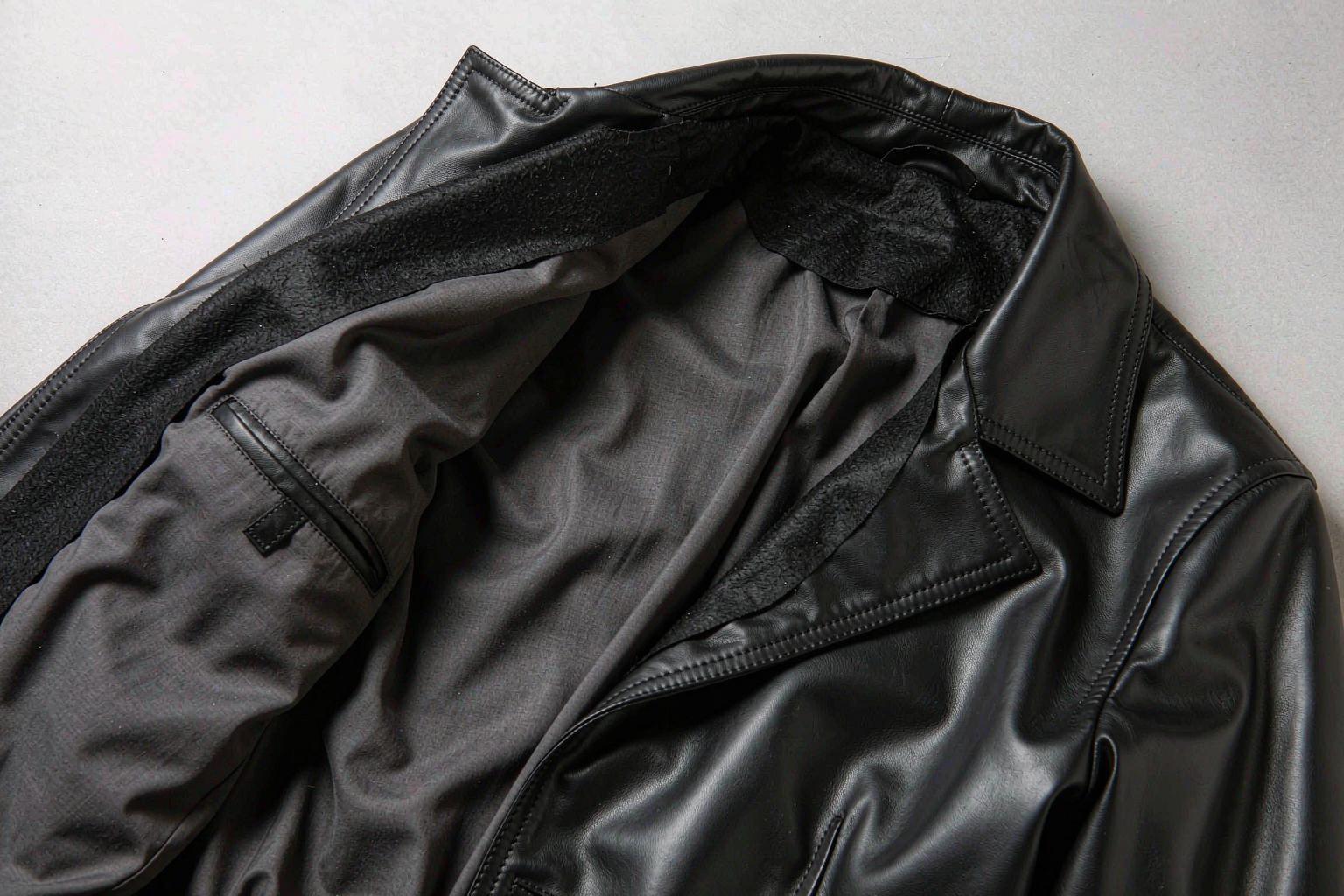
The lining itself is usually a plain weave polyester or a satin. The weight matters less than the slip. A lining that grips the leather makes the jacket feel stiff. One that slips too freely lets the shell twist on the body. Ask for the lining cut on the same grain as the shell. A bias-cut lining stretches and pushes the leather out of shape from inside.
Hardware that survives a season
Zips on leather jackets fail at the bottom stop. The leather is thick, the snap or zip base sits on multiple layers, and the slider has to push through that stack every time the jacket is closed. A size 5 aluminium zip is the common default. It is light enough to move through the layers and strong enough for daily wear. A size 3 zip, which is what you find on shirts and lightweight garments, will fail on a leather jacket within a season.
Snap hardware is the other weak point. Snap hardware gets ordered by diameter and finish, not by pull strength. On leather, the snap base has to sit flat against the hide without distorting it, and the socket has to hold the stud under tension without pulling through. Ask for the snap to be set with a washer backing on the inside of the placket. Without the washer, the snap pulls through the leather in about three months of shop handling.
Colour, light and how leather fades
Leather dye fades under light, and it fades unevenly. The shoulder fades faster than the body, because it catches more sun on a display rack. The inside of the collar barely fades at all. A shade approved on a cutting room table under fluorescent light will look like a different colour in a shop window after six weeks.
AATCC TM16-3:2020 is the published xenon-arc method for colourfastness to light, and it measures exposure in AATCC Fading Units. The method is written for textiles, but the principle applies to dyed leather. Expose a sample to controlled light, compare it with an unexposed reference, and put a number on the difference. Ask whether the leather was tested for lightfastness. If it was not, keep the jacket off the shop window, or expect the shoulder to be a shade lighter than the body by mid-season.
FAQ
Q1: What is a custom leather jacket?
A jacket made to your own specification of shell material, pattern, lining, interlining, hardware and colour. A stock jacket with a logo added is not the same thing, because none of the structural decisions were yours.
Q2: Should we use real leather or PU?
Both work. Real leather breathes, stretches and takes a patina. PU is stable, consistent and cheaper. The choice depends on the price point and whether the buyer wants the jacket to age or to stay the same.
Q3: Why does the collar droop after a few weeks?
Missing or insufficient interlining at the collar and front placket. The leather shell does not hold its own shape. The interlining does that job, and without it the collar and the front opening collapse.
Q4: How thick should the PU be?
Between 0.8 mm and 1.4 mm for outerwear. About 1.2 mm is a safe starting point for a first range. Thinner creases at the elbow, thicker makes the front placket difficult to close.
Q5: Can we match colour across two suppliers?
You can try, but dyed leather varies hide to hide, and two suppliers using the same dye name will not produce the same shade. Buy the full order from one batch if colour consistency matters. PU is more consistent but still varies between production runs.
Q6: What snap size do we need?
Size 18 line snaps with a washer backing. The washer stops the snap pulling through the leather. Without it, expect failures within three months.
Closing notes and further reading
Choose the shell material, then the pattern, then what holds the jacket together inside. The thickness bands and test methods above are published references, not any factory’s readings. Put them to a supplier as questions and record the answers in writing.
For related outerwear guides: Utility Style Guide: How to Wear Workwear-Inspired Outfits, Winter Workout Clothes Guide. And for the brand story, One Hundred Pieces.