How an Independent Apparel Brand’s Ambition Took Root Across 6,800 Square Meters in Yiwu
| “The following chapters are not about our factory. They are about an entrepreneur who staked two full years of hard-earned life savings on just one hundred sets of loungewear.” |
Prologue · Four O’Clock in the Morning in Yiwu
Yiwu’s dawn always begins with the rumble of freight trucks.
At four-thirty, the high-bay floodlights across the logistics park flicker to life first. Then come the roll-up metal doors, rattling upward one after another into the grey morning air, as if unseen hands were gently pulling back the city’s quilts. Loaders stack corrugated cartons chest-high; a tape gun screeches with a sharp rip, pulling out half a meter of tape, the crisp sound echoing across the open tarmac. Inside those boxes are hair scrunchies, holiday baubles, phone mounts, and plastic water bottles—Yiwu’s global renown was pieced together, cent by cent, from millions of these modest, everyday sundries.
Yet on the other side of this bustling city, workshops are packing an entirely different kind of carton. Inside is apparel.
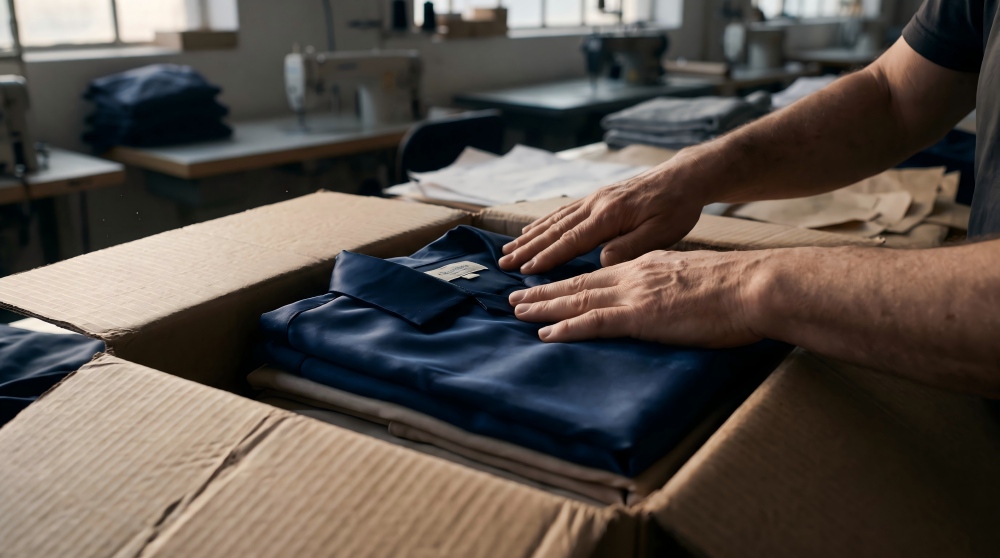
Each garment is neatly pressed, folded with care, slipped into an individual crystal-clear polybag, affixed with a precise size sticker, and stacked into master cartons strictly according to color and size ratios. And before the final sealing tape is pulled across the box, the packer instinctively reaches in one last time, gently smoothing flat the collar of the garment lying at the very top.
That quiet gesture has never been written into any production tech pack or standard operating procedure. It is simply a maker’s parting courtesy to a piece of clothing before it journeys out into the world.
We have been doing this, quietly and faithfully, for over thirty years.
Chapter 1 · One Hundred Pieces
Lin’s very first inquiry email was barely two hundred words long.
She was twenty-seven, living and working in Vancouver. By day, she served as an assistant at an interior design consultancy; by night, sitting at her desk, she sketched the silhouettes of her dream fashion brand. Her concept was streamlined to a single debut capsule: premium satin loungewear. She had saved for two entire years, launched an independent Shopify website, produced editorial lookbooks, and cultivated a loyal following of more than four thousand people on Instagram—followers who showed up in her comment section every evening asking the exact same question: “When can we finally buy this?”
She ran the figures over and over in her spreadsheet. Her initial batch: exactly one hundred sets. If they sold out cleanly, she would reorder three hundred more. As a self-funded solo founder, this was the absolute ceiling of financial risk she could afford to shoulder.
She sent inquiry emails to eleven garment export factories. Nine never replied. One responded with a curt, non-negotiable minimum order quantity (MOQ) of 1,000 units. The final factory answered promptly and politely: a $300 sample fee (strictly non-refundable), with a 45-day development timeline.
On the eleventh day, she found us.
In traditional mass apparel manufacturing, “one hundred pieces” is an awkward, almost undignified figure.
It isn’t that factory managers are inherently arrogant or dismissive; it is that the mathematics of industrial production is uncompromising. To build a padded, quilted jacket from scratch requires an identical, rigid sequence of technical steps: pattern drafting, grading across size specs, marker plotting, CNC quilting template fabrication, machine calibration, trial stitch tests, needle-detection scans, and customized packaging. In garment engineering, these represent fixed “setup costs.” They do not bend with order volume—whether you produce one hundred garments or ten thousand, every single one of these steps must be executed in full.
Consequently, the smaller the batch, the more punishing the fixed cost allocated to every single garment. At a volume of just one hundred units, the unit manufacturing cost can be up to 40% higher than on a mass order of ten thousand.
Textile procurement is even more restrictive. Commercial dye houses typically require a minimum dye run of 300 to 500 meters per dye vat. A typical jacket consumes approximately 1.6 meters of fabric; one hundred jackets require only 160 meters—nowhere near enough to fire up an industrial dye vat. Commercial fabric mills will not initiate a bespoke dye cycle for such a modest yardage; they will simply reply: “We do not stock this specific shade in open inventory.”
And so, on the quotation sheets of nearly every conventional manufacturer, the words “one hundred pieces” are simply industry code for “We are sorry, but we cannot help you.”
When we replied that we could take the order, it wasn’t because we were running a charity. It was because our supply chain architecture was intentionally engineered to handle small-batch agility:
- A Network of 220+ Vetted Fabric Partners: When your required yardage cannot fill an industrial dye vat, we do not force you to compromise on your color palette. Instead, we immediately query our vast supplier network: Which partner holds sixty meters of this exact weave as surplus inventory in their warehouse?
- 6,800 Square Meters of Self-Operated Warehousing: We stock evergreen staple textiles year-round and provide in-house small-batch cutting, sparing emerging founders from being forced to buy entire wholesale fabric bolts upfront.
- A 5-Person In-House Pattern Studio & Proven Silhouette Archive: If your creative concept aligns closely with one of our proven foundation blocks, adapting an existing pattern is exponentially faster and far more economical than drafting completely from scratch.
- 200+ Fresh Seasonal Samples Developed Every Quarter: New brands do not need to struggle over a terrifying blank canvas. Founders can easily build upon an already balanced silhouette—modifying a neckline, adjusting a hemline, or swapping an accent stitch.
When we replied to Lin’s email, we didn’t bombard her with standard export jargon or payment terms. We asked her only three simple questions:
1. In what real-life moments do you envision people wearing this piece?
2. When the fabric brushes against the skin, do you want it to feel refreshingly cool and sleek, or gently warm and cocooning?
3. What brand name do you plan to stitch onto the neck label?
It took her a long time to reply. When she finally did, she confessed that while other factories had grilled her endlessly on minimum order volumes and upfront deposits, no one had ever asked her what name she was going to put on the label.
Chapter 2 · Seven Days of Sampling
Sample turnaround: exactly seven days.
Seven days was never a marketing gimmick invented to hook prospective clients; it was an uncompromising, hour-by-hour operational production schedule.
- Day 1 — Translating Design Vision into Technical Reality: We analyzed her mood boards, sizing specifications, and the exact ruffled edge she envisioned. When a client says “ruffles,” the technical sheet must quantify it into a precise “gathering ratio.” When she requests “an effortless, relaxed drape,” our pattern makers translate that into “an additional 8 cm ease across the bust line.”
- Day 2 — Pattern Engineering & Digital Grading: Our senior master pattern maker translates two-dimensional concepts into precision-cut, production-ready paper blocks.
- Day 3 — Toile / Muslin Prototyping: We stitch a preliminary test garment using unbleached calico cotton—bypassing the main production lines entirely—specifically to inspect structural silhouette, balance, and proportions. Many workshops eliminate this step to cut overhead. We never do. If the underlying silhouette is flawed, all the expensive silk and delicate topstitching in the world cannot salvage it.
- Day 4 — Fabric Quality Inspection & Precision Cutting: The production-grade satin arrives, passes through inspection, and is cut.
- Day 5 & 6 — Workshop Sewing, Live-Model Fit Testing & Refinements: Assembly on the sewing line, fit verification on live dress forms, and fine-tuning details.
- Day 7 — Steam Finishing, Full Inspection, Photo Documentation & Dispatch: Final quality checks, studio photography, and priority international courier pickup.
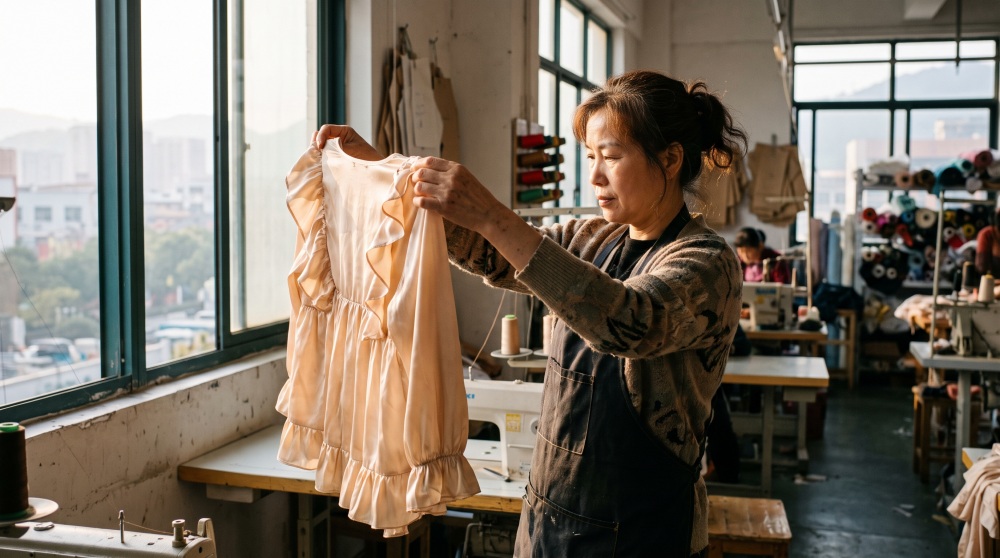
Across those seven days, the most exacting challenge was that seemingly simple ruffled hem.
In garment construction, ruffles are the most deceptive detail. To an untrained observer, it is just a gathered strip of cloth; yet that very gather dictates whether an article feels understatedly luxurious or visibly cheap. Shifting the gathering ratio from 1:1.8 to 1:2.2—using the exact same silk-satin and the exact same hem width—alters the garment’s entire character. At 1:1.8, the folds are overly dense and rigid, looking stiff like a uniform; adjusted to 1:2.2, the pleats fall naturally and loosely, swaying gently with every step.
Our sample seamstress adjusted it three times. On the third pass, she held the garment up against the workshop window, letting the morning sunlight filter through the delicate layers of gathered satin, smiled, and said: “Now it breathes.”
Quilted padding requires the same meticulous consideration.
Quilting joins the face fabric, insulating batting, and lining into a unified whole. Diamond, wave, and cloud stitch motifs each demand unique templates and machine calibrations:
- Diamond Quilting: Provides the crispest structural stiffness, ideal for structured outerwear.
- Wave Quilting: Delivers the softest, most pliable drape—perfect for cozy loungewear you want to live in all day.
- Cloud Quilting: Features generous, airy stitch spacing for high loft, but demands absolute uniformity in batting distribution.
Lin chose the wave pattern.
During sampling, we also integrated a subtle functionality she hadn’t specified in her initial tech pack: an internal slip pocket.
Not an external patch pocket, but an interior chest pocket sewn seamlessly into the inner lining, sized precisely to slide in a smartphone and two payment cards. On a blueprint, this addition occupies just a single line of text; on the workshop floor, it demands recalibrating the lining marker layout, an extra cutting run, an additional stitching step, and another quality checkpoint.
Mass-volume factories routinely reject such requests as inefficient. We added it anyway for a simple, human reason: when someone is unwinding at home and stands up to answer the doorbell, pick up food delivery, or take a quick phone call, they shouldn’t be forced to awkwardly juggle their phone in their hand.
| “The true excellence of a garment often lives where the casual observer cannot immediately see.” |
On the fourteenth day, Lin received her package in Vancouver.
She later told us that what moved her first wasn’t even the garment itself, but the reassuring weight of the carton. It felt far more substantial than she had envisioned. Inside rested the professionally steamed sample, an organized swatch ring of companion fabrics, a handwritten technical adjustment sheet, and a small roll of surplus fabric cut from the exact same dye lot.
She didn’t understand why we had included that small remnant and asked us about it. We explained: “Textile dyeing always carries minor batch variations. If a garment ever needs alterations or repairs down the road, this piece ensures your repair matches your original color down to the exact dye lot.”
Chapter 3 · Two Hundred and Twenty Paths
A wholesale textile market is a sprawling city within a city.
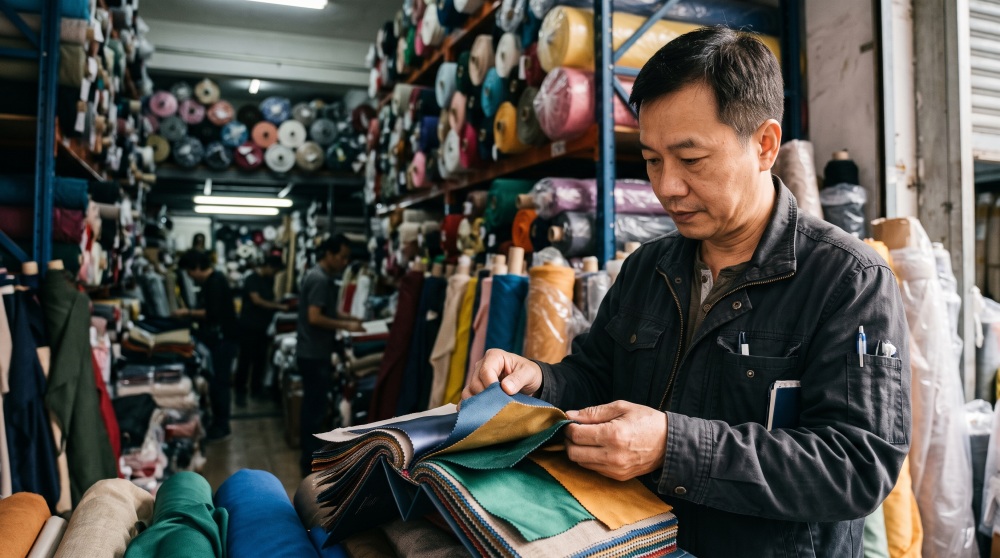
Floor upon floor rises upward, trading stalls pressed shoulder-to-shoulder, heavy bolts of fabric stacked clear to the ceiling. As you walk the narrow aisles trailing your fingertips across the rolls, your hands encounter an endless spectrum of textures: fluid silks, dry-hand linens, velvety fleeces, and responsive stretch knits. Evaluating colors beneath commercial stall lighting is notoriously misleading; warm spotlights flatter and distort true pigments. A seasoned fabric merchant always carries the bolt out into natural daylight, flips it over, and closely inspects the weave density on the reverse side.
We frequently print on our profile: “Partnered with over 220 premier fabric suppliers.” To an outsider, that number looks like factory bravado—a boast of operational scale. But its real value lies not in how broad it is, but in how narrow the path can be.
| “A fabric mill willing to sell you 10,000 meters of standard cloth is conducting everyday commerce. A fabric supplier willing to climb high warehouse racks to track down sixty meters of premium inventory for your 100-piece order is honoring a relationship built over thirty years of trust.” |
Where do emerging apparel brands most often stumble? It is rarely from a shortage of creative vision or digital marketing buzz; it is being stopped cold by the sentence: “This specific fabric color has no open stock, and the mill will not dye a sample roll for you.”
When Lin first engaged with us, she sent over twenty-seven smartphone photos taken under various lighting angles.
Smartphone cameras lie constantly. The same champagne satin appears cool and muted near an overcast window, soft off-white under a warm desk lamp, and rich vintage cream when filtered. Those three screenshots correspond to three distinct dye formulation codes and three entirely different raw-material price tiers. Furthermore, physical drape—whether the fabric glides across skin without cling, whether it possesses structural bounce, whether it flows like water when you open your palm—can never be conveyed through a screen.
That is why we adhere strictly to a practice that seems almost quaint in the digital era: we ship physical fabric swatches worldwide, completely free of charge.
In an industry saturated with slick digital renderings, mailing real fabric swatches remains the most honest way to win a client’s trust. Because when it comes to textiles, human fingertips can never be fooled.
Chapter 4 · Even One Hundred Pieces Must Pass Under the Same Lamp
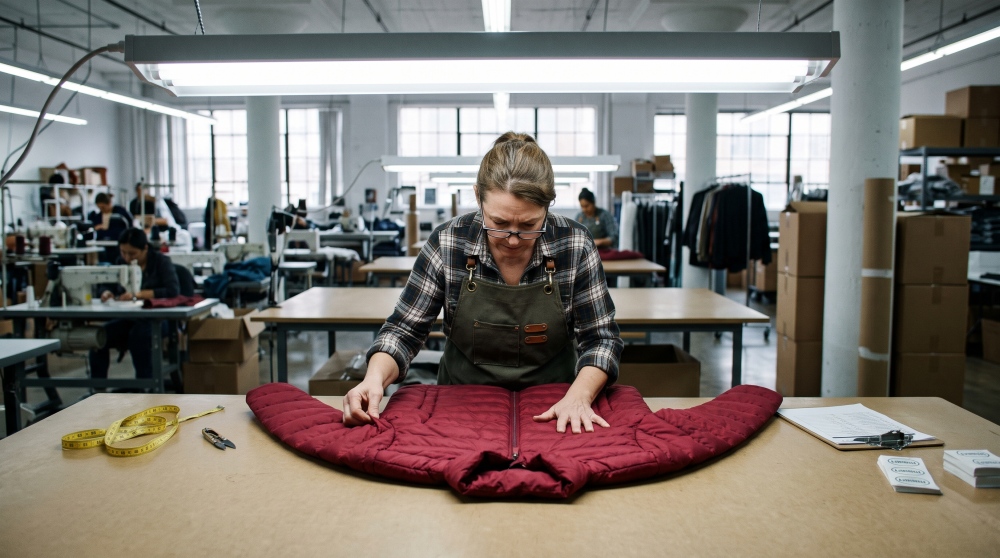
Inside our final quality assurance workshop stands an array of high-intensity inspection lamps.
Beneath their calibrated cool-white illumination lies the inspection table. When a garment is smoothed out across the surface, microscopic needle marks, dropped stitches, faint lubricating oil specks, or quilting seams misaligned by even two millimeters have nowhere to hide.
Our facility reliably handles a monthly throughput of 150,000 garments. In that vast volume, an order of one hundred pieces represents a microscopic 0.07%. Yet when those one hundred garments come off the sewing line, every single one is laid across that exact same inspection table, scrutinized under that exact same light, and held to the exact same standard. Not a single quality gate is skipped.
What poses the greatest threat to small-batch production? Batch shade variation (dye lot variance).
One hundred garments might require cutting from two separate dye vats. Even when following the identical digital formulation code, slight shifts in ambient temperature or vat humidity can introduce subtle tonal variations. Viewed together in a warehouse, the difference might go unnoticed; but viewed individually in open sunlight, the variance reveals itself. A retail customer buys only one garment—she won’t compare it to the rest of your inventory, but your online review section certainly will.
Our protocol for small-batch runs is uncompromising: prioritize single-lot cutting. If multiple lots must be used, the order is strictly separated by dye batch, boxed independently, and clearly labeled on the master carton.
We would rather require your overseas fulfillment center to manage two separate SKU variations in inventory than let two slightly mismatched color tones slip into the unboxing experience of your end customers.
Furthermore, we back every shipment with an unconditional 30-day garment quality guarantee.
Offering this level of backing in the competitive garment export sector is not a boast that our production lines are immune to human error; it is because whenever a defect occurs, we absorb the cost ourselves. We calculate the cost of rework and international reverse logistics with total transparency, and we cover it willingly.
On an order of one hundred pieces, a manufacturer’s profit margin is razor-thin. But if an emerging brand’s reputation is crushed by negative reviews on its maiden collection, the loss isn’t a small margin—its business is wiped out entirely.
Chapter 5 · From One Hundred Pieces to Ten Thousand
Lin’s inaugural batch of one hundred sets sold out completely in nineteen days.
For her second season, energized by the response, she expanded to three hundred sets and introduced an exclusive seasonal colorway.
By the third season, she wanted to develop a coordinated, matching loungewear set (Co-ord)—a padded jacket paired with matching bottoms. That breakthrough came directly from our sample room: while visiting our facility to review swatches, she spotted leftover offcuts from a quilted jacket lying on the cutting table and asked, “Could we take this exact quilted fabric and draft a pair of wide-leg trousers?”
Our answer was immediate: “Yes. We can have a prototype ready for fit testing tomorrow.”
In her fourth season, she captured the peak holiday shopping rush with a limited-edition gingerbread print, crafted in festive crimson and trimmed with soft white plush along the cuffs and lapels.
By her fifth season, her order volumes had expanded so significantly that her production runs had to be scheduled well in advance alongside our high-volume export lines.
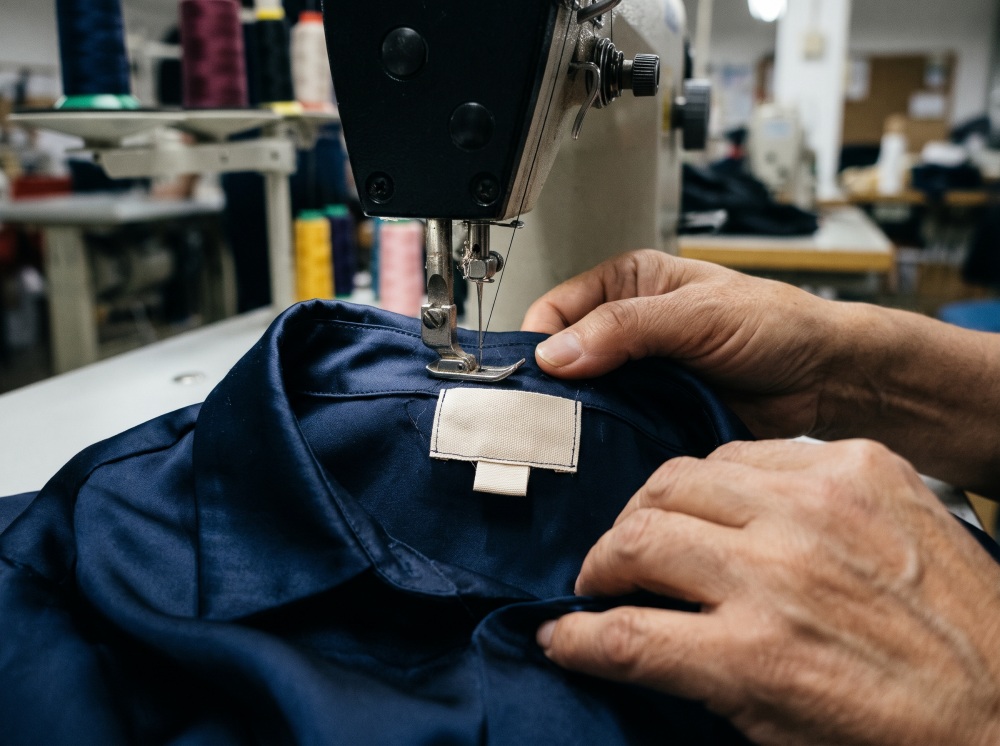
Her production figures grew a hundredfold, yet one essential detail remained constant: sewn into the center of every single neckline was her brand’s own custom woven label.
On our formal quotation sheets, there is a routine line item: “Custom Private Labeling (Woven Neck Tag & Care Label Application).” In black-and-white print, it looks like nothing more than an operational checkbox.
Yet for an independent founder who began with just one hundred pieces, that single line represents the heartbeat of her brand.
Because regardless of the complex industrial machinery humming behind the scenes—from CAD pattern engineering and quilting machines to needle detectors and export packing—all of that labor ultimately converges behind that small woven label. And the name woven onto that label is not ours. It is hers.
Reflecting on her journey, Lin realized she never needed to become an expert seamstress or master textile engineering.
A brand founder’s true responsibility is knowing precisely what her audience desires, and communicating that vision with absolute clarity. The remaining manufacturing heavy lifting is faithfully carried out across eight rigorous industrial stages:
| Design Deconstruction → Textile Sourcing & Testing → Fabric Pre-Treatment (Pre-shrinking & Softening) → Pattern Cutting → Muslin Fit Prototyping → Batch Sewing Assembly → 100% Quality Inspection & Needle Detection → Export Packaging & Logistics |
These eight foundational stages hold no industrial secrets; virtually any manufacturing facility can recite them. The only real divide is how many of those stages are faithfully executed by the hands on the floor, and how many exist merely as diagrams in a sales deck.
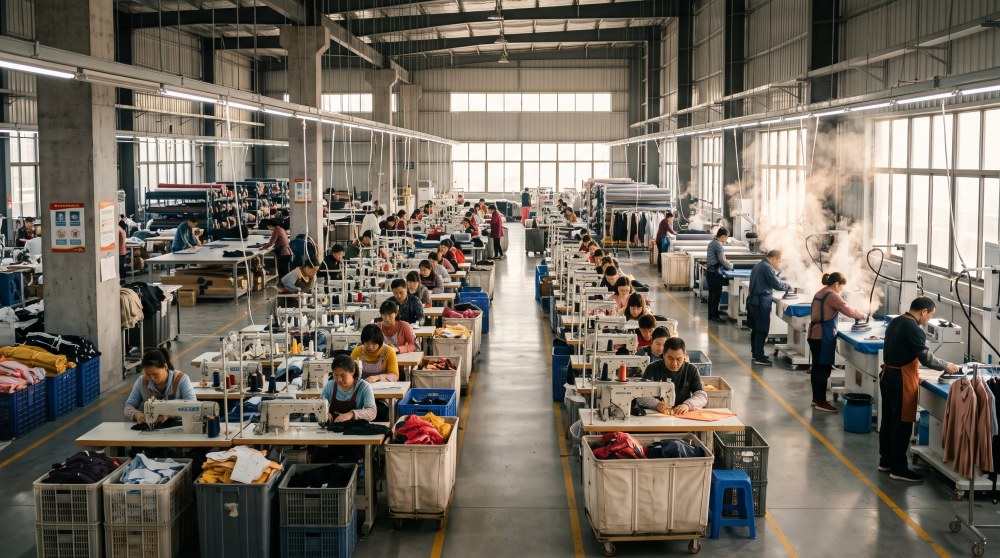
Chapter 6 · The People in the Workshop
More than five hundred skilled craftspeople work within our facility.
When hundreds of machines run simultaneously, the sound inside the workshop isn’t the sharp, clattery racket often depicted in movies. It is a deep, continuous, rhythmic hum—like a steady summer downpour murmuring against a broad roof. Spools of thread spin fluidly atop sewing heads; steam rises perpetually from the pressing tables, billowing upward before being whisked away by high-capacity exhaust ducts. At eleven-thirty, the savory aromas from the company cafeteria drift down the corridor, cleanly dispelling the faint metallic trace of sewing machine oil.
Every autumn during the Chongyang Festival, employee volunteers visit neighborhood care centers with bags of rice, cooking oil, and seasonal fruit, sitting in the courtyards to share quiet conversations with elderly residents. Twice a year, municipal blood donation buses park at our gates, and the line of workers rolling up their sleeves stretches from the workshop floor across the courtyard. At our monthly company birthday celebrations, the candles on the sheet cake never match the actual number of honorees, simply because there are too many birthdays to count.
These community moments might seem completely unrelated to manufacturing garments.
Yet, in truth, they are the very foundation of garment quality.
In the garment industry, the greatest operational hurdle has never been creating a single stunning design; it is achieving unwavering industrial consistency.
The first production sample must be identical to the two-thousandth bulk garment. The batch delivered this autumn must feel identical in the hand to the batch delivered last spring. And that rigorous standard rests upon a very fundamental human premise: the people sewing today’s garments must be the same skilled hands who crafted yesterday’s.
In a high-turnover sweatshop reliant on transient temporary labor, every new production run is placed into unfamiliar hands. A novice stitcher’s wrist slips, and a seam allowance widens by five millimeters; an operator rushes through pattern matching, and a quilted line skews by two millimeters; a worker hurrying to hit piece-rate quotas skips a reinforcing backstitch at a pocket corner. Individually, each deviation might slip past basic tolerance thresholds; but across a retail display, the collective impression is unmistakable: “This batch feels unfinished.”
Our employee turnover has remained remarkably low for decades. Not because we offer tech-bubble salaries, but because ordinary craftspeople are treated with respect, and people feel secure staying here year after year.
Epilogue · Six Thousand Eight Hundred Square Meters
Six thousand eight hundred square meters—roughly the dimensions of a regulation international soccer pitch.
Within this space operate more than two hundred modern computerized sewing and automated template machines, an active 5-person pattern studio, over five hundred dedicated workers, and a vertical staging warehouse stacked high with textiles.
While our corporate entity was registered in 2013, the textile heritage practiced by our artisans in Yiwu has been refined for over thirty years—progressing from foot-treadle machines in the 1980s, to high-speed electric flatbeds in the 1990s, to today’s computerized CNC pattern stitching systems and automated laser cutters.
Generations of machines have come and gone, but certain habits have never changed: before any master carton is sealed for export, someone still reaches in, gently smoothing the collar of the top garment flat.
As boxes are readied for dispatch, one of three standard international trade terms (Incoterms) is stamped on the shipping label:
- DDP (Delivered Duty Paid): We manage customs export clearance, ocean freight, destination import customs, and local inland delivery—bringing the shipment right to your warehouse door.
- EXW (Ex Works): Your freight forwarder picks up cargo directly from our loading dock, maximizing your shipping flexibility.
- FOB (Free On Board): We transport the container safely to the domestic seaport and complete Chinese export clearance, leaving ocean transit under your direction.
Three logistical paths, representing three reliable ways to shepherd an entrepreneur’s dream across the ocean.
Over the years, we have worked with many founders who started with just one hundred pieces, exactly like Lin.
They rarely possess corporate warehouses, fleets of commercial buyers, or venture funding. What they carry is a pure concept, and an uncompromising refusal to settle for mediocre mass-market goods.
And our purpose—the reason we built these workshops and maintain these production lines—is to ensure that even a dream of one hundred pieces is given the craftsmanship, respect, and dignity it deserves.