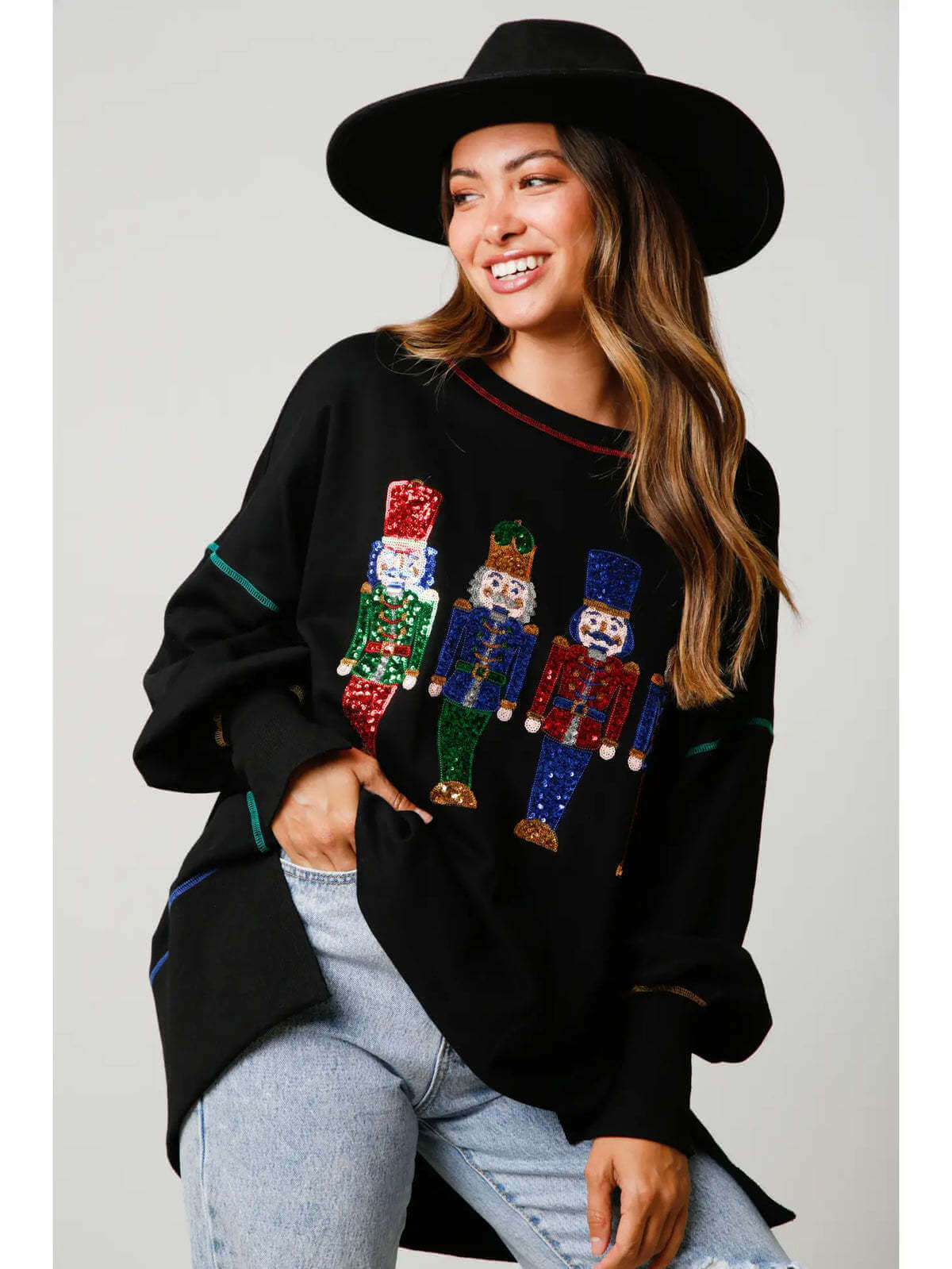
Launching your own independent home clothing brand or introducing custom pajamas with logos to your fashion boutique is an exciting milestone. Customized nightgowns not only perfectly showcase brand image and enhance customer experience, but also bring higher retail premiums to products.
However, for start-up and emerging brands, entering the clothing manufacturing supply chain for the first time may feel at a loss. How to handle small-scale production, how to do brand customization, how to choose fabrics, every step requires strategy. Unlike large-scale assembly line production that often involves thousands of pieces, small batch customization requires close cooperation between the brand and the factory to ensure both quality and profit margins.
This guide will provide you with a detailed breakdown of the complete process, core technical points, and industry pitfalls for customizing a logo nightgown, helping you achieve instant success in your first mass production.
Part 1: Standard Customization Process
Understanding the operation of the production line can help you plan the brand’s launch time reasonably and have clear and practical expectations for the overall progress. A standard custom nightgown order typically consists of the following five stages:
Step 1: Design communication and Tech Pack confirmation
It all starts with your design concept. You need to provide the factory with your design ideas, expected size chart (such as European and American standard sizes, or one size fits all), and high-resolution brand logo vector image files (in AI, EPS, or PDF format).
Step 2: Fabric and Color Selection
You need to select the base material for the nightgown (such as cotton, bamboo fiber, or mulberry silk) and confirm the color. Most factories will provide standard Pantone color cards for you to choose from; If your order volume reaches a specific scale, the factory can also provide you with exclusive customized dyeing services.
Step 3: Sampling and Clothing Confirmation
Before the bulk production is officially launched, the factory will produce a physical sample garment with a customized logo according to your requirements. This step is crucial as it allows you to personally touch the drape of the fabric, check the pattern and size, and strictly control the production process and visual effect of the logo.
Step 4: Bulk Production
After you confirm that the sample clothes are correct and pay the deposit, the factory will officially schedule production. This includes fabric cutting, logo processing, garment sewing, strict quality control (QC), and independent packaging.
Step 5: Quality Inspection and Shipping
After the final quality inspection of the bulk goods and you pay the final payment, the nightgown will be packaged and shipped. You can choose air freight express delivery (fast speed, high cost) or sea/rail transportation (slower speed, but most cost-effective for large quantities of goods).
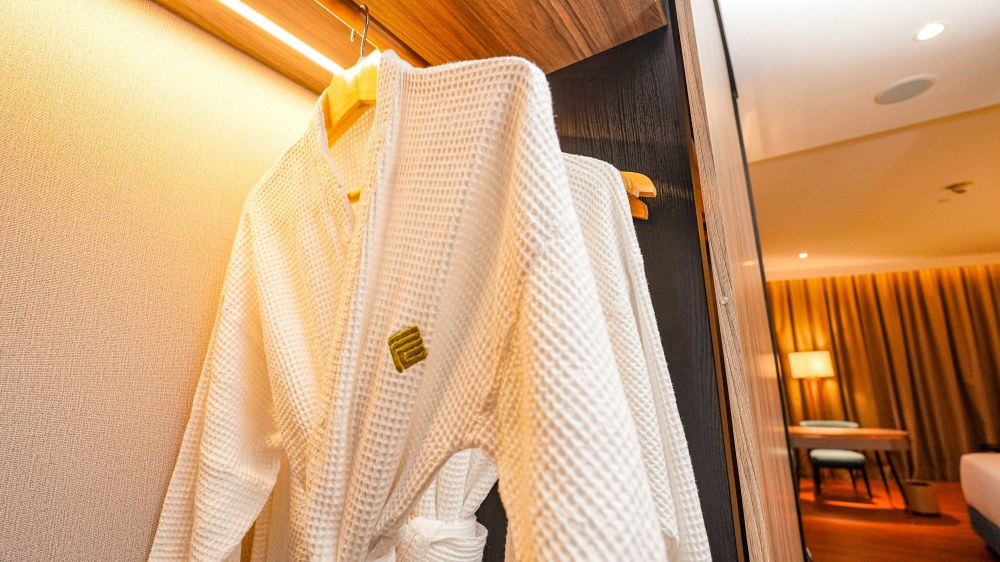
Part 2: Logo Production Process – Choose Embroidery or Printing Based on Fabric
One of the most common pitfalls for start-up brands is the mismatch between logo craftsmanship and fabric. Your brand logo may look perfect on a computer screen, but its actual presentation on fabric depends entirely on the material of the nightgown.
Embroidery: a classic choice that highlights texture
Embroidery is using high-quality embroidery thread to directly weave your logo into the fabric. It can bring a slightly convex three-dimensional touch, presenting a high-end and wear-resistant visual effect, and is synonymous with luxury quality.
- The most suitable fabrics are high weight cotton (looped fabric, cut velvet), waffle fabric, and thick bamboo fiber fabric.
- Attention: Embroidery itself has weight and hardness. If used on extremely lightweight fabrics (such as 100% mulberry silk or delicate imitation silk/polyester satin), extensive embroidery will pull and damage delicate fibers, causing wrinkles in the fabric and creating a strange sagging sensation when wearing the entire nightgown.
Printing (screen printing/digital direct printing): Smooth and brightly colored
The printing process involves directly printing or curing dyes onto the surface of the fabric.
- The most suitable fabrics are real silk, synthetic silk, and lightweight Modal/viscose fiber blended fabrics. Digital printing is perfect for presenting complex patterns, multi-color gradient logos, and seamless all over prints.
- Attention: It is highly recommended not to print on fabrics with obvious concave and convex textures such as waffles, thick loops, or fleece. Uneven surfaces can cause printed patterns to crack, deform, or peel off over time.
Expert advice: Logo must be simplified as much as possible
On customized nightgowns, ‘less is more’ is the golden rule. Complicated logos with small slogans, extremely fine lines, or complex shadows are difficult to perfectly replicate on textile fabrics.
Simplify your brand visual: If your main logo contains complex illustrations or small words, design a simplified visual specifically for the chest, cuffs, or back of your nightgown – such as an elegant monogram, an iconic icon, or a clean plain text trademark. A simple logo not only looks cleaner and more sophisticated, but also greatly improves the factory’s production yield.
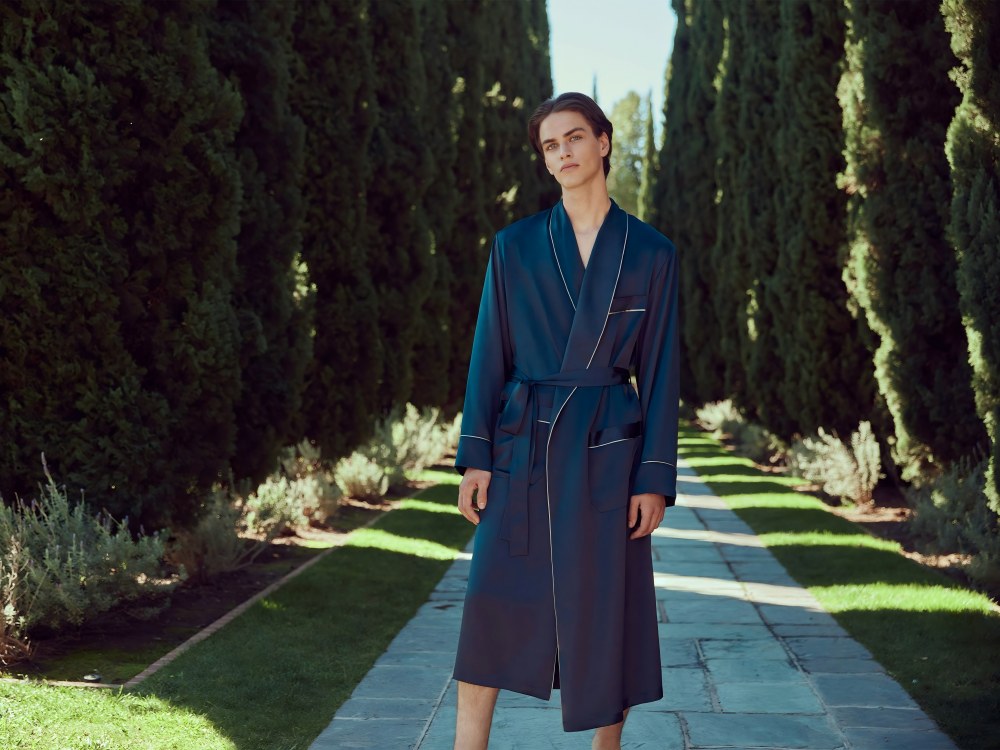
Part Three: Recognizing Reality – Why Do Custom Chemical Plants Have Minimum Order Quantity (MOQ) Restrictions?
As a startup brand, your primary goal is usually to control inventory to ensure the safety of cash flow. However, when you need a truly “customized” nightgown, meeting the factory’s minimum order quantity (MOQ) as much as possible is the key to facilitating cooperation.
Why do factories have to set a minimum order quantity? Because customized production means that factories have to sacrifice more hidden costs and production efficiency in the workshop:
- Machine debugging cost: Adjusting embroidery or printing machines for a customized logo is very time-consuming. If a factory suspends machines, recalibrates, and changes wiring for an order of only 10 or 20 pieces, the labor cost of a single piece of clothing will skyrocket exponentially.
- Fabric dyeing and loss: Industrial cutting machines require a certain length of fabric to operate efficiently. A small order quantity can lead to a high rate of fabric loss during cutting, and this high cost of raw material waste can only be borne by the factory itself.
- Worker productivity: Sewing workers have the fastest speed and lowest error rate when repeatedly sewing the same pattern. If the design, size, and stitching are frequently changed due to micro orders, the production rhythm of the entire workshop will be disrupted.
The compromise solution for start-up brands: take a step back from each factory. Instead of asking for “5 colors, 4 sizes, and only 50 pieces in total” when placing your first order, it’s better to try to integrate your needs. You can start with just one of the most classic and popular colors (such as elegant white or classic black) and use combination sizes (such as S/M and L/XL). This can help you easily achieve the factory’s total minimum order quantity for bulk orders, while also keeping your total investment budget within a safe range.

Part Four: The Golden Rule of Startup Brands – Clear Requirements, Avoid Frequent Changes
In the manufacturing industry, clarity is money. The most successful brand factory partnership is always built on “determined and unchangeable technical requirements”.
Why do you have to lock in all the details as soon as possible?
After the bulk production has been arranged, frequent changes in design, size, fabric color, or logo position can be a disaster for both the brand and the factory.
- Error chain occurrence: Even if you just want to “slightly adjust” the position of the pocket after the fabric has been cut, it can trigger a domino effect, causing the logo to be misaligned or the needle and thread to not match.
- Delay in project schedule and additional costs: If you change your mind after confirming the samples, the factory must readjust the machines, purchase new raw materials, and push your order to the end of the production queue. This will not only cause you to miss the launch period of the brand’s new products, but also incur additional lost labor and material costs.
What preparations should you make before contacting the factory?
To ensure the certainty of your brand requirements, please complete the following two points before placing an order:
- Conduct market research: Identify your target customers so that you don’t have to worry about size standards or fabric feel halfway through production.
- Thoroughly and rigorously test the sample clothes: treat the sampling stage as your final assessment. Wash it, try it on, test the firmness of the logo, and then compile all the modification suggestions into a list and submit it to the factory at once. Once the final sample is signed and confirmed, it will be immediately locked and no further changes will be made.
Conclusion: Establishing long-term supply chain partnerships
Finding custom logo nightgowns for your startup brand is not just a simple buying and selling transaction, it is the starting point for establishing brand supply chain partnerships. The factory is very willing to grow together with growth oriented brands that have planning, clear processes, and basic knowledge of production.
By simplifying the logo, matching the process with the fabric, respecting the factory’s minimum order quantity, and maintaining demand stability, you can ensure a smooth and unobstructed manufacturing process. In the end, you will receive a series of high-quality customized nightgowns that will captivate your customers at first sight and lay an unbreakable foundation for the brand’s long-term development.
Are you ready to put your custom nightgown collection into reality? Our factory specializes in providing high-end fabrics and small batch (low MOQ) customized solutions for emerging brands. Contact our supply chain experts immediately to initiate your project consultation.