An MOQ Is a Cost Projection, Not a Policy
A factory that quotes “300 pieces minimum” is not quoting a rule. It is quoting the number of units it takes to cover fabric, the dye lot, and setup labor without losing money. Once you read an MOQ that way, the whole negotiation shifts: you stop asking for a favor and start removing the cost items that push the number up.
This is written for brand owners and sourcing managers planning a first or next custom apparel order. It covers what actually sets your minimum, realistic ranges by category, and the levers that lower the number without wrecking quality.
What “MOQ” Actually Means
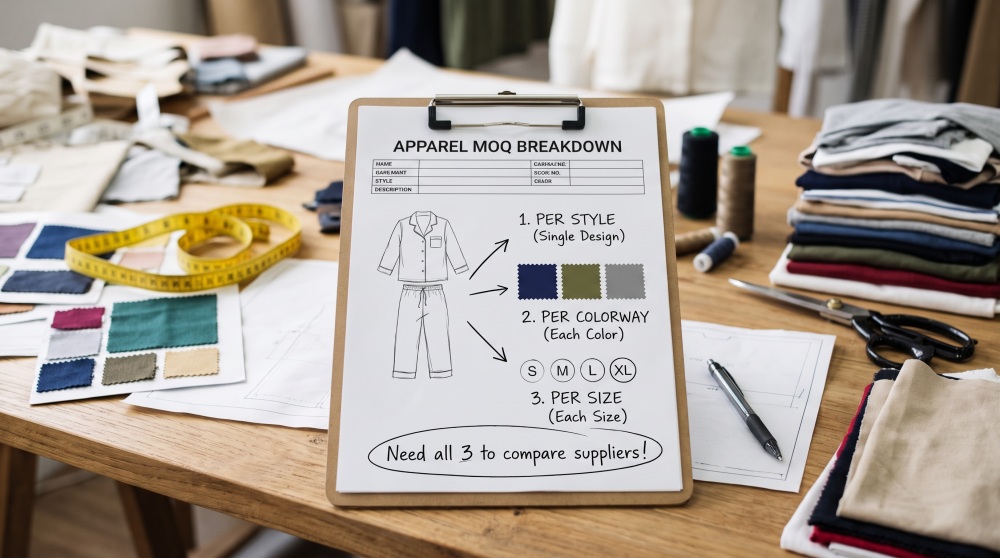
MOQ — minimum order quantity — is the smallest production run a factory will accept. In apparel it is rarely one number. It usually splits three ways:
- MOQ per style — the minimum for a single design.
- MOQ per colorway — the minimum for each color inside that style.
- MOQ per size — less common, but some cut-and-sew shops apply minimums per size within a size set.
A quote that says “MOQ 300” without breaking out style, color, and size is not a quote yet. You need all three to compare suppliers or plan inventory.
Why the Number Is What It Is
The factory is not being difficult. The minimum sits at the point where an order covers fixed costs. Four things push it around.
Fabric dye-lot minimums. A knit mill will not run a dye lot for ten meters. Most knitted fabric carries a dye-lot minimum of roughly 200–500 kg per color. If your style consumes 0.4 kg per piece, one color alone forces a run of several hundred pieces. Mills hold color to lab-dip standards set by bodies like AATCC, which is exactly why they refuse short dye runs. This is the single biggest driver of apparel MOQs.
Setup and labor. Cutting, sewing-line setup, and finishing take the same setup whether you buy 100 pieces or 1,000. That setup has to spread across the units you order.
Decoration setup. Embroidery digitizing, screen printing screens, and woven label plates are one-time costs. They do not move the MOQ, but they make a small run look expensive per piece.
Process complexity. A three-piece set with contrast panels, binding, and embroidery carries a higher minimum than a single-garment tee. The more operations, the higher the floor.
Typical MOQs by Category
The ranges below are industry norms, not promises. Exact numbers depend on your spec.
| Category | Typical MOQ per style / colorway | Main driver |
|---|---|---|
| Stock / blank tees, hoodies | 50–300 pieces | Fabric already in stock |
| Custom cut-and-sew basics | 300–500 per colorway | Dye-lot minimums |
| Denim | 300–500 per wash | Wash-batch processing |
| Knitwear / sweaters | 300–500 pieces | Yarn dye-lot minimums |
| Jackets / outerwear | 300–1,000 pieces | Hardware, lining, construction |
| Fully custom printed styles | 500 pieces minimum | Screens, multiple colors |
The pattern is consistent: the more custom fabric and decoration a style carries, the higher its minimum. The fastest route to a low MOQ is stock fabric plus a proven block. If your line needs certified material — organic cotton, low-impact dyes, or OEKO-TEX-certified materials — the floor rises further, because certified greige goods are bought in smaller, more expensive lots.
The Levers That Actually Lower MOQ
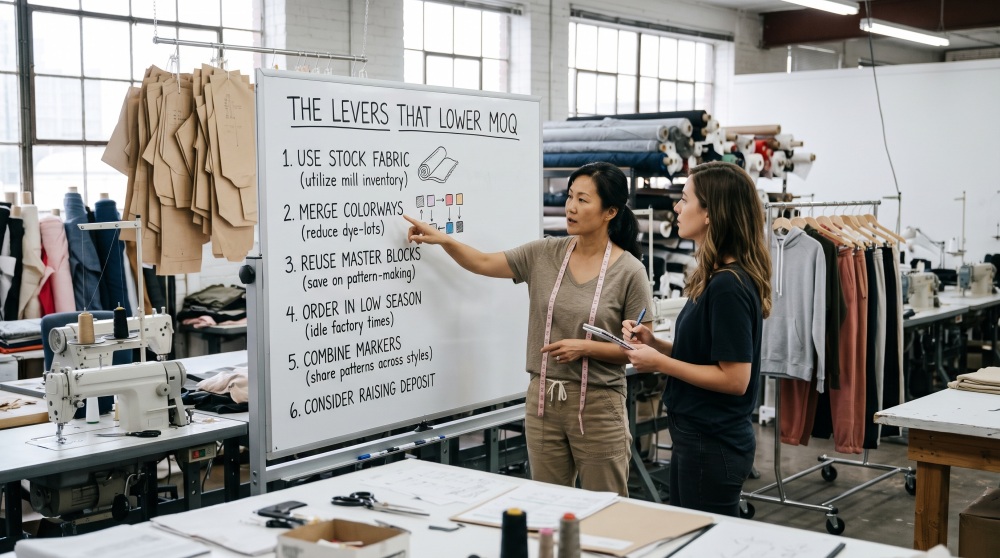
Dye-lot cost is not negotiable, but you can remove or shrink the cost items behind it.
| Lever | What it does | Watch out for |
|---|---|---|
| Merge colorways | Fewer colors means fewer dye lots | Do not flatten the product line |
| Use stock fabric | Choose from the mill’s existing inventory | Selection is limited |
| Reuse the master block | Skip new grading and sampling | Fewer rounds, and faster |
| Order in the low season | Factories take small runs when idle | Confirm lead time, not just MOQ |
| Combine markers across styles | Two styles share one cutting marker | Sizes and colors must be compatible |
| Raise the deposit | Some factories lower the MOQ for prepaid orders | Get the terms in writing |
One approach never works: asking “can you do 100 pieces?” on its own. What the factory hears is “can you do 100 pieces at a loss?” Find out which cost items set the minimum, then attack them one at a time.
Red Flags in a MOQ Quote
- No style or colorway breakdown. A minimum with no per-color split is a number, not a quote.
- The number keeps moving. A different figure in every email means nobody costed the job.
- Unconditional “no MOQ.” No minimum usually signals a trading company adding margin, not a factory.
- A first-order-only MOQ. Acceptable — but the reorder minimum belongs in writing.
A Straight Answer
Wingtu Apparel is one of many options. We do full-category custom apparel — tees, hoodies, pants, outerwear, shirts, polos, knitwear, denim, and loungewear — with in-house design, verifiable construction, and cost-effective sustainable production. We are not the factory that takes 20,000-piece rigid orders or non-apparel projects. If your line is apparel and you want a straight answer on minimums, send your spec and we will tell you what is actually feasible.
FAQ
Q: What is the MOQ for custom apparel?
A: It depends on category and spec. Stock styles often start at 50–300 pieces per colorway; custom cut-and-sew styles usually sit at 300–500 per colorway because of dye-lot minimums. Fix the spec first, then ask for the number.
Q: Can I get a lower MOQ for a first order?
A: Usually, yes — stock fabric, merged colors, a reused fit block, or a low-season order all help. A larger deposit can too. Get every concession in writing.
Q: Why is the MOQ higher for custom colors?
A: Mills run dye lots in minimum quantities, generally 200–500 kg per color. A custom color commits that whole lot, and it spreads across your pieces. Stock colors sidestep it.
Q: Is “no MOQ” a good sign?
A: Rarely. A real factory has fabric and setup costs to cover. “No MOQ” usually signals a trading company adding margin. Ask who actually manufactures the goods.
CTA
Send us your tech pack or a rough brief, and we will walk through the MOQ layers with you — style, color, fabric, and the levers that lower the number.
Get a Quote