If you’ve been in the kids’ apparel game for more than a minute, you know the drill. Every winter, parents come in looking for the thickest, heaviest parka they can find, thinking “bulk equals warmth.” But as those of us on the manufacturing and supply side know, that’s just not how heat physics works.
Lately, there’s been a massive shift. I’m seeing more B2B buyers—from boutique owners in Scandinavia to big-box distributors in the US—asking for “system-based” clothing. They aren’t just buying jackets; they’re buying a solution. That solution? The Sandwich Layering Method.
In this deep dive, we’re going to break down why this three-layer approach is the gold standard for kids, what fabrics you should be sourcing, and how to sell this concept to a market that’s tired of “disposable” winter fashion.
What Exactly is the “Sandwich Method”?
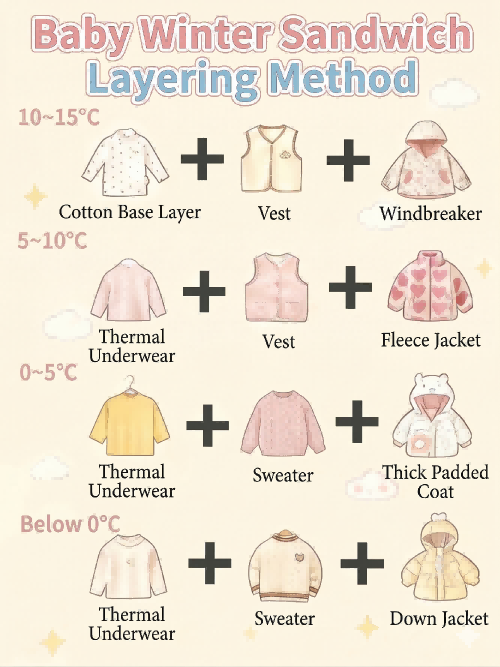
The “Sandwich Method” (or 三明治穿衣法 as we call it in China) isn’t about food. It’s about air. Specifically, it’s about trapping dead air between layers to create a thermal barrier. For a child, whose body temperature can fluctuate wildly between a sprint across the playground and sitting in a cold car, this system is a lifesaver.
It’s built on three functional pillars:
- The Inner Layer (The Bread): Moisture management.
- The Middle Layer (The Filling): Heat retention.
- The Outer Layer (The Crust): Weather protection.
Let’s get into the nitty-gritty of each layer.
Layer 1: The Inner Layer – Keeping the Skin Dry
I’ve seen so many brands mess this up by using 100% heavy cotton for base layers. Big mistake. Cotton is a “thief.” It sucks up sweat, stays wet, and then sits cold against the skin. If the base layer fails, the whole “sandwich” falls apart.
Why Sweat is the Enemy
Kids are little heat engines. They run, they sweat, they stop. If that moisture doesn’t move away from the skin, they get the “cold creeps.” For B2B sourcing, you want fabrics that are hydrophobic (water-hating) on the inside and hydrophilic (water-loving) on the outside to pull that moisture away.
- Best Fabrics: Synthetic blends (polyester/spandex), Merino wool (the king of natural performance), or brushed “milk silk” fabrics.
- Key Specs: 180-220 GSM is usually the sweet spot for a winter base.
A quick side note: I once worked with a client who insisted on super-thick base layers. We found out the hard way that if it’s too thick, the kid can’t even bend their elbows. Keep it thin, keep it stretchy.
Layer 2: The Middle Layer – The Warmth Engine
This is where the actual insulation happens. The goal here is to create “loft.” You want a layer that is slightly loose—not baggy, but enough to hold a layer of warm air.
The Power of the Vest (Waistcoat)
If you’re a wholesaler, pay attention to vests. Vests are the unsung heroes of the Sandwich Method. They keep the core warm—where the vital organs are—while leaving the arms free for play. Plus, from a business perspective, they are easier to size and have lower return rates than full-sleeve sweaters.
Materials to Source:
- Polar Fleece: Cheap, durable, and dries in a heartbeat.
- Knitted Sweaters: Great for that “premium” boutique look, but make sure the wool isn’t “itchy.” (Nobody wants a crying toddler in their store).
- Down-lite Gilets: It is best suited for temperatures between 0 and 10 degrees Celsius.
Layer 3: The Outer Layer – The Protective Shield
This is your windbreaker, your parka, or your down jacket. This layer doesn’t necessarily need to be “warm” on its own—it needs to be tough.
Wind, Water, and Breathability
In the B2B world, we talk a lot about “5K/5K” or “10K/10K.” For the uninitiated, that’s waterproofness and breathability.
- Waterproof: Keeps the rain/snow out.
- Breathable: Allows the moisture from Layer 1 to finally escape into the atmosphere.

The Strategic Advantage for B2B Buyers
Why should you care about the Sandwich Method? Because it changes your inventory strategy.
Instead of betting everything on one “super jacket,” you can offer a modular collection.
- Cross-selling: A customer buying a jacket is now a prime candidate for a matching fleece vest and a set of thermal underwear.
- Seasonality: You can sell these components separately as the weather transitions from autumn to deep winter.
I’ve noticed that retailers who display these three layers together on a mannequin see about a 25% increase in multi-item transactions. It’s just common sense—show them how it works, and they’ll buy the whole set.
Real-World Scenario: The School Run vs. The Weekend Hike
Let’s look at how this plays out for a real family (your end-users).
- The School Bus ($5\text{°C}$ to $10\text{°C}$): The kid wears the base layer + a fleece vest + a light windbreaker. When they get to the classroom, they ditch the windbreaker and stay comfy in the vest.
- Snow Day (Below $0\text{°C}$): We swap the vest for a heavy sweater and the windbreaker for a high-fill-power down jacket.
As a supplier, if you provide these “interchangeable” parts, you become a one-stop shop for the retailer.
Conclusion
At the end of the day, winterwear for children isn’t just about fashion—it’s about engineering. The Sandwich Layering Method offers a scientific yet simple way to keep kids safe and comfortable. For those of us in the B2B space, focusing on moisture-wicking bases, loft-heavy mid-layers, and weather-resistant shells is the best way to build a brand that parents trust. Stop selling “coats” and start selling “climate control.”
Your customers will thank you, and more importantly, their kids will stay warm enough to actually enjoy the snow.
Frequently Asked Questions (FAQs)
1. Can I just use a thick coat instead of the Sandwich Layering Method?
You could, but it’s not ideal. A single thick coat doesn’t breathe well and can’t be adjusted. If the child gets too hot, they take the whole coat off and then they’re freezing. The Sandwich Layering Method allows for “fine-tuning” the temperature throughout the day.
2. What are the best fabrics for the “inner layer” in children’s clothing?
For B2B sourcing, look for synthetic blends or Merino wool. Avoid 100% cotton for active kids because it holds moisture. The goal is to get a fabric that stays dry and soft against the skin, even when the child is running around.
3. Is the “middle layer” always necessary?
In milder winters (around $10\text{°C}$ to $15\text{°C}$), you might skip a heavy sweater, but a thin vest is usually a good idea. The Sandwich Layering Method is flexible—you add or remove the middle “filling” based on the actual thermometer reading.
4. How do I explain this concept to my retail customers?
The easiest way is to use the “Sandwich” analogy. Tell them the inner layer keeps the skin dry (bread), the middle layer holds the heat (filling), and the outer layer stops the wind (crust). Using simple visuals or infographics in your showroom can really help drive the point home.
5. Does the outer layer need to be oversized?
It should be “comfortably loose.” If the outer shell is too tight, it compresses the middle layer and “squeezes out” the warm air you’re trying to trap. A little bit of extra room actually makes the clothing warmer.