A Merchandiser, a Client, and Seventy-Six Days of Twelve Hundred Coats
| NARRATOR & FACILITY Zhou Min, Senior Merchandiser (9 Years) Export Apparel Manufacturing Hub, Yiwu, China | CLIENT & BRAND Elin, Founder & Creative Director Independent Outerwear Studio, Copenhagen, Denmark |
| ORDER SCOPE & TIMELINE 1,200 Quilted Coats in Custom ‘Birch’ Shade 76-Day Production Cycle | Fall/Winter Collection | CORE VALUE PROPOSITION True partnership isn’t making decisions for clients; it is ensuring they see what the factory sees. |
Prologue: One Minute and Forty-Seven Seconds
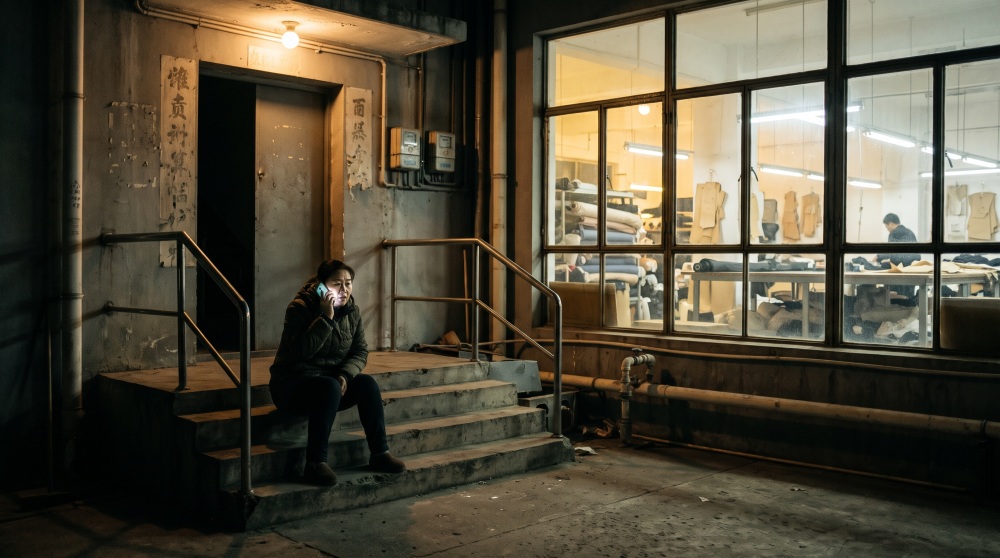
It was 2:11 AM when I sat down on the cold concrete steps outside the workshop, listening to her voice note.
One minute and forty-seven seconds.
In Copenhagen, it was 8:00 PM; she must have just locked the heavy glass doors of her studio. Through the phone’s speaker came the hollow whistle of Baltic wind and the sharp, echoing cadence of her boots striking wet cobblestones.
I didn’t need to listen past the first fifteen seconds to know the order was in serious danger.
Her voice came through low, measured, and tightly wound: “Min, I saw the inspection photos. Can you tell me honestly—on those three hundred coats, how bad is the delta?”
I didn’t reply immediately. I sat on those steps for nearly ten minutes, watching the fluorescent hum leaking through the workshop glass. Over by the main cutting bay, the overhead industrial tubes were still burning bright. Lao Chen was guiding his vertical steel blade through another production run, the rhythmic rasp of steel parting woven cotton echoing in waves across the quiet courtyard.
Then I tapped the microphone icon, held the phone to my lips, and answered:
“Not by much. But enough to matter.”
My Job Is Translation
I have spent nine years inside this factory.
When I first walked through the security gates, I was an assembly-line seamstress sitting in the third row, setting armholes. Back then, my daily quota was four hundred armholes. Heavy, yellowed calluses formed across the pads of my thumbs, split open under needle friction, bled, healed, and hardened again. Later, I moved into greige inspection, and eventually transitioned into merchandising. Today, I handle accounts for more than forty overseas clients scattered across seven countries and three distinct time zones.
During my first year as a merchandiser, I made a grave mistake.
A client had requested “off-white” (米白). When I wrote out the workshop traveler ticket, I carelessly penned “milky white” (奶白). Two characters in Chinese. Exactly half a shade on the optical color spectrum. When bulk manufacturing wrapped up, the client emailed a crisp, high-resolution photo with a single question: “Is this the shade I approved?”
I took her original lab swatch, walked to the D65 daylight inspection booth, and stood there utterly frozen. I couldn’t utter a single syllable of defense.
That entire production run had to be discounted at a devastating loss. The factory owner never yelled at me. He just leaned against the cutting table and said quietly: “Min, from this day forward, your only real job is to make sure the client sees what you see.”
It took me nine full years to genuinely understand what he meant.
| “Clients never just buy a garment. What they are actually asking is whether the delicate image living inside their head can survive the journey into physical reality.”— Zhou Min, Merchandiser |
At its core, apparel merchandising isn’t administrative paperwork. It is translation.
When an overseas designer writes, “I want this jacket to feel softer,” I cannot simply hand those words to the workshop floor. The workshop does not run on poetry; it runs on mechanical parameters. “Soft” means adjusting the gathering ratio from 1:1.8 to 1:2.2. Or it means dropping the inner thermal batting from 160 grams down to 140 grams. Or expanding the quilted diamond grid from six centimeters to eight. One single word—three mechanical pathways, three completely different cost structures.
When a client says, “This tone lacks sophistication,” my job is to extract the optical truth: Is it overly saturated? Does it carry too much yellow undertone? Is it muddy in shadow? Then I hold the physical lab dips beside a north-facing window, comparing them angle by angle until she finally exhales: “Right there. That’s the one.”
A client once told me something that stayed with me for years. She said: “Min, I want this coat to feel like my grandmother’s overcoat.”
It took me two full weeks of textile forensics to translate that emotional memory into a technical spec sheet: wool-blend, 580 grams per square meter, mild fulling on the finish, brushed nap combed strictly downward, and lined in pure cupro. Why cupro? Because cupro feels cool against bare skin when you first slide your arms into the sleeves—and her grandmother’s coat was cool to the touch.
Elin was the third international account I managed after stepping into merchandising.
She is Danish, in her early forties, with a decade of rigorous experience as a European fashion buyer before she poured her personal savings into founding her own independent label. In Year One, she entrusted us with three hundred pieces. Year Two grew to eight hundred. By Year Three, we arrived at this milestone: twelve hundred diamond-quilted winter coats in a proprietary hue she blended herself.
She christened the color “Birch.”
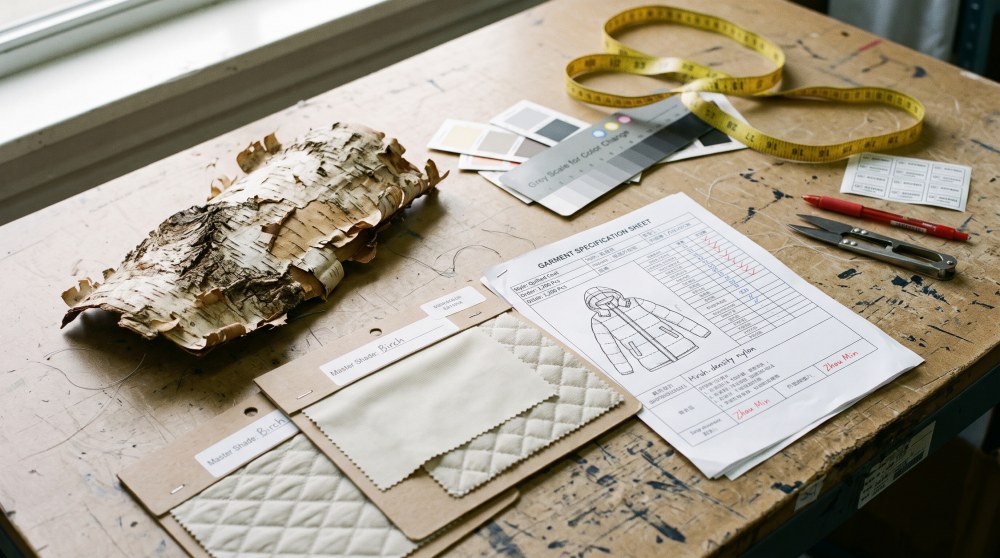
It was an agonizing shade to reproduce. It wasn’t ivory, wasn’t oatmeal, and wasn’t cement grey. It was the exact hue revealed when you peel away the dry, papery outer skin of a northern birch trunk in late autumn—the pale, vulnerable fibrous layer underneath, carrying a whisper of Scandinavian frost paired with an imperceptible breath of organic warmth.
She mailed me a real piece of birch bark. An authentic strip of dried wood bark slipped into an airmail envelope, shipped five thousand miles from Copenhagen to Yiwu. The international postage cost ten times more than the bark itself.
I laid that brittle strip of bark on my inspection table and studied it for hours.
One Color Code, Two Vats
Lab dips took four exhausting rounds.
Round one was too chalky; round two leaned too golden; round three died in muddy grey. In round four, the dye mill yielded two strike-offs: one leaning half a degree warm, the other half a degree cool. We air-shipped both to Denmark. She selected the cooler strike-off.
That ten-centimeter square of dyed poplin became our golden master—the standard sample. We stapled it to the very first page of the master tech pack, and it accompanied this production run for seventy-six consecutive days.
The fracture occurred during bulk fabric dyeing.
Twelve hundred coats in a single unified color. Even our regional dye house’s largest continuous vat couldn’t process that much yardage in one run. The yardage had to be split across two separate dyeing vats. In apparel manufacturing, vat variation is an accepted reality. On the contract, we stated explicitly: Both dye lots must calibrate against the approved golden master, and Delta E must remain strictly within internal quality tolerance.
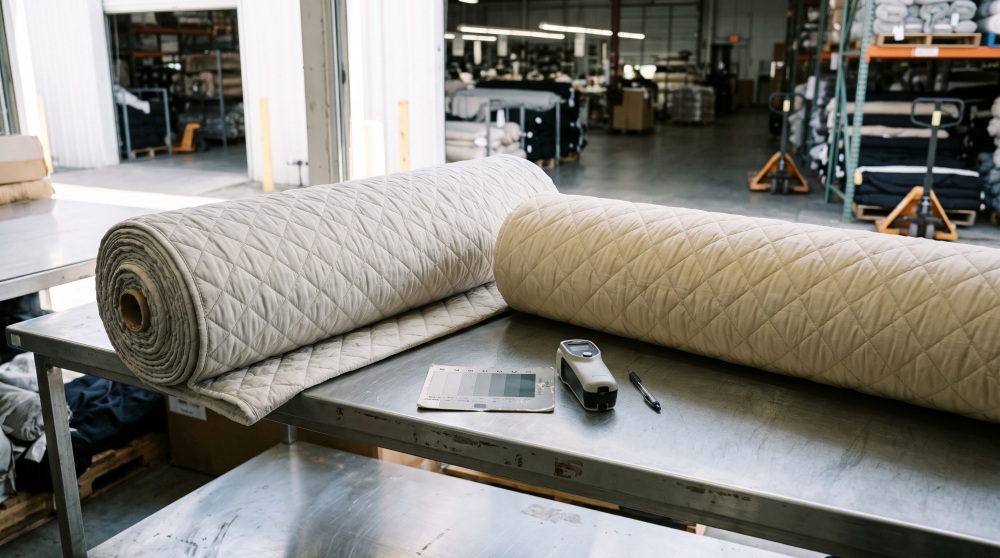
Vat One arrived at our loading dock. We unrolled the bolts across the inspection table. It was dead-on.
Vat Two arrived forty-eight hours later.
I stood at the fabric inspection perch, flipped on the overhead light, and within three seconds, my stomach tightened.
It wasn’t a subtle ‘slight variance.’ It was the kind of deviation that looks tolerable under fluorescent workshop tubes, but the instant you drag a bolt out to the loading bay under open natural daylight, the divide hits you like a slap. Vat One was pristine northern birch. Vat Two looked like birch bark that had baked under three straight days of July sun.
I pulled out the grey scale cards and spectrophotometer readings.
It was out of spec.
How far out? In our industry, color fastness and shade matching are measured on a standard five-grade grey scale. Our internal QC threshold demands Grade 4.0 or above. Vat Two registered between 3.5 and 4.0.
What does Grade 3.5 to 4.0 mean in the real world?
It means that ninety percent of end consumers looking at an isolated jacket hanging in a boutique closet will never notice. It means if we quietly blended the cut bundles together and stuffed them into shipping cartons, we might have made it through the entire winter without a single formal customer service complaint.
Or it means that two friends who pre-ordered the coat meet for coffee in Copenhagen, take a selfie outdoors in natural daylight, post the side-by-side shot to Instagram with the caption, “Why are our coats two completely different colors?”, and a boutique label built on perfectionist design suffocates in its infancy.
And three hundred coats’ worth of fabric had already passed through the spreader and under the cutting knife.
I Made the Call
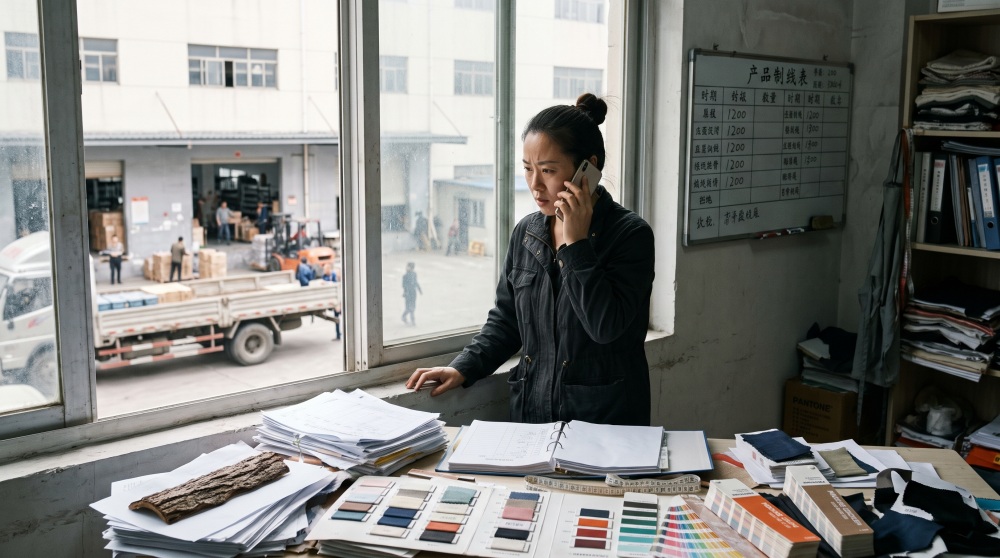
When I dialed Elin’s direct line, it was 4:00 PM in Yiwu and 10:00 AM in Copenhagen.
She answered from her studio. In the background, I could hear the tinny, erratic clatter of a domestic sewing machine—she still sewed her own rough sample mockups, even if her stitching wasn’t pretty.
“Elin,” I said without preamble. “Vat Two has a shade issue.”
Her voice tightened instantly: “How many pieces?”
“Three hundred. The panels have already been cut.”
The line went dead silent. Then came the phrase I have heard dozens of times from desperate brand owners facing delivery deadlines:
“Ship them anyway. I’ll handle whatever happens.”
I took a deep breath. “No. I can’t do that.”
We Had a Fight
That was the first time we ever raised our voices at each other in three years of working together.
“Zhou Min,” her voice trembled with furious adrenaline, “I have four hundred individual customers who paid in full months ago. My pop-up flagship opens on November 7th. You’re telling me you’re withholding three hundred coats two weeks before the launch?”
“I know you have four hundred pre-orders,” I said.
“You don’t know anything!” she shot back. “To you, it’s just twelve hundred units on an assembly line!”
A second later, a notification pinged on my phone screen. A screenshot from her Instagram direct messages. The text was in Danish, and she translated it through the receiver, her voice cracking with raw emotion:
“I saved my wages for three whole months just to buy this coat.”
She paused, breathing hard. “Min, I have fifteen messages just like that sitting in my inbox right now.”
The weight of those words settled into the pit of my stomach.
Outside my office window, a heavy flatbed truck was backing into the loading bay. Beep. Beep. Beep. Slow, mechanical, indifferent.
“Elin,” I said, keeping my voice as steady as I could. “I don’t know who those four hundred women are. But I know this: if we sneak those three hundred off-shade coats into the shipment, you won’t have twelve hundred orders next autumn. You won’t have a brand.”
“That is my commercial risk,” she snapped. “I’m the founder. I absorb the risk.”
“No,” I replied. “It’s your risk. But it’s my product.”
The silence that followed stretched forever. Across six thousand miles of fiber optic cables, all I could hear was the rustle of rain against her studio glass in Copenhagen and her heavy breathing.
Then she dropped a cold, defensive line: “You are an OEM vendor. Your contractual obligation is to execute what I instruct.”
I said: “My job is to make sure you are still in business five years from now.”
She slammed the receiver down.
I sat motionless, phone clutched in my sweat-stained palm. Across the room, Xiao Liu looked up from his keyboard, stared at me with wide eyes, said nothing, and quietly turned back to his monitor.
I knew I had spoken out of turn. It sounded arrogant, like a lecture. Brand founders don’t hire factories to be preached to about survival.
But deep down, I knew I couldn’t let those boxes leave the dock.
It had nothing to do with standard contracts. On paper, the order stipulated AQL 2.5 general inspection level. Under a loose AQL audit, this lot technically squeaked past the statistical threshold.
I refused because I had watched this exact tragedy unfold four times before.
Brands rarely perish because of flawed conceptual designs, nor do they die because of price points. They die from tiny, seemingly invisible compromises: one off-tone batch, a consumer sharing a photo, comments asking “Is this factory second or fake?”, return rates spiking past twenty percent, marketplace algorithms choking organic visibility, cash flow freezing, and the label vanishing overnight.
I have watched that slow death four times.
And in three of those four disasters, the factory had simply done “exactly what the client told them to do.”
Those Three Days
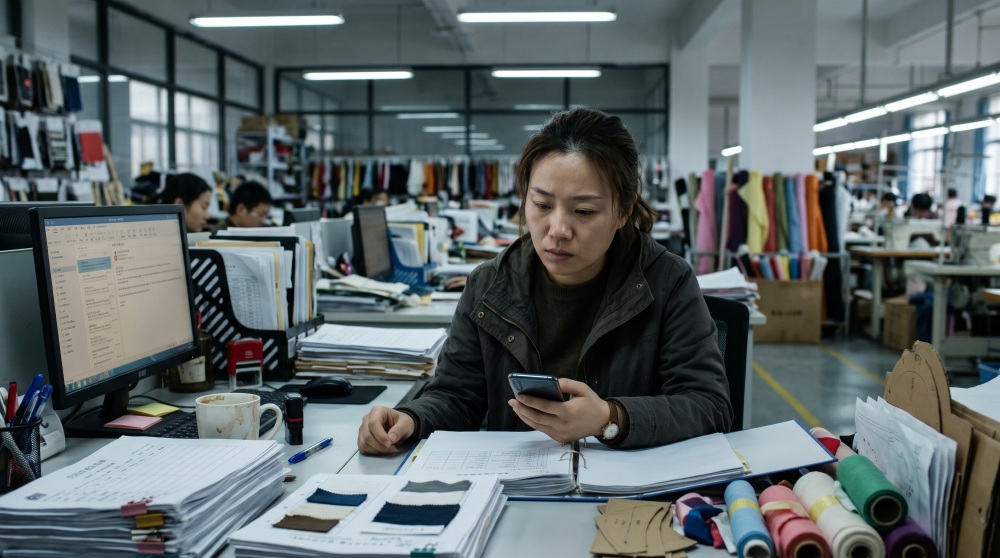
Over the next seventy-two hours, I took four decisive actions.
Action 1: Sourcing Replacement Textile
Birch was a bespoke reactive dye recipe; there was not a single meter of open-stock inventory in any regular market warehouse. I made nineteen phone calls. On the seventeenth call, a secondary greige converter in Shaoxing checked his warehouse records: a Scandinavian client had defaulted on an export run the previous winter, leaving behind 420 meters of identical high-density nylon taffeta in the exact raw spec.
420 meters. With a pattern consumption of 1.6 meters per coat, that was enough for 260 garments.
At 6:00 AM the next morning, I boarded the intercity bus to Shaoxing. The fabric rolls were buried in the deepest alcove of the warehouse, pinned beneath three heavy wooden skids. As we hauled them into the alleyway, clouds of gray dust billowed into the morning air. I took my tailor shears, snipped a six-inch swatch, and stepped into the open courtyard under natural overcast light.
It was an uncanny match.
Standing in that cold warehouse alley, my eyes suddenly stung with tears. Not just out of exhaustion, but because I knew: out of the three hundred doomed coats, one hundred and eighty could be saved.
The remaining one hundred and twenty were gone.
Action 2: Re-engineering the Production Schedule
I rushed back to Yiwu and marched straight into the master planning office. The factory was running at full capacity—150,000 garments on the monthly floor plan, each order slammed back-to-back.
I slammed the fabric swatch on the planner’s ledger: “We need to slot one hundred and eighty coats into Line Three.”
The planner glared at me: “Are you out of your mind? If we insert a rush run, two domestic bulk orders get delayed.”
“Then delay them,” I said.
He scoffed: “Do you have any idea what late penalty clauses cost?”
“I do. I’ll take it to the General Manager.”
The boss listened quietly as I laid out the math. When I finished, he asked only one question: “Does this rush lot make us any money?”
I looked him straight in the eye: “None. Factoring in rush dyeing, overtime premiums, and air freight, we lose money on this order.”
He was silent for five seconds. Then he picked up his pen and signed the traveler slip: “Get it on the line. Never let an overseas client think that once goods clear the gate, they’re on their own.”
Action 3: Mobilizing the Workshop
Cutting the pieces was one thing; sewing twelve hundred intricate diamond-quilted chambers was another. Normal throughput for 180 complex quilted jackets is twelve days. We had five.
I went directly to Workshop Group Three. The supervisor, Sister Wang, is forty-six, possessed the fastest seam hands in the district, and was famous for her razor-sharp temper.
I showed her the bundle: “Sister Wang, 180 coats. We need them boxed in five days.”
She stopped her machine, pushed her reading glasses up her forehead, and laughed bitterly: “Five days? Are you having a stroke?”
“I know it violates every schedule we have,” I murmured.
She stood up, wiped her hands on her apron, and stared at me: “Give me one good reason why my girls should burn their wrists for this.”
I told her the entire story. I told her about the envelope with the real birch tree bark, the split dye vats, and the young woman in Europe who saved three months of wages for a single jacket.
Sister Wang listened without interrupting. When I stopped talking, she turned on her heel and shouted down the long humming aisle of forty sewing machines:
“Team Three! Voluntary overtime tonight! Anyone who wants to stay, clock the blue sheet!”
That evening, nineteen machinists stayed behind.
Over the four days that followed, they worked through the midnight hours. On night three, I walked past station eight and saw one of the young girls fast asleep with her forehead propped against the cast-iron machine arm, her fingers still clasped tight around a cut collar band.
Action 4: Midnight on the Cutting Table
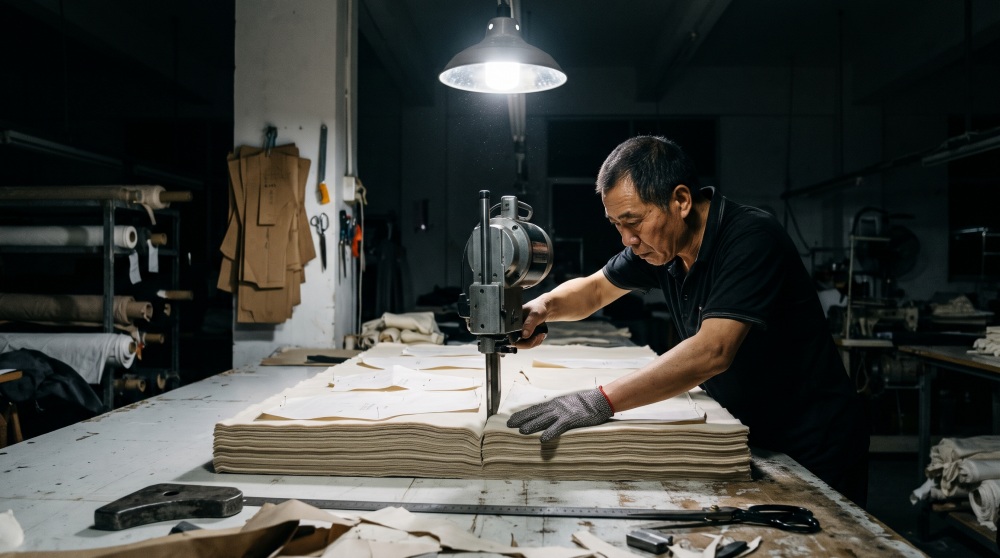
Lao Chen’s heavy-duty cutting table sits in the darkest corner of the ground floor. At 10:00 PM, when I hauled the replacement rolls through the plastic dust curtains, he was already packing his toolbox, pulling down the master circuit breakers one by one.
“Lao Chen,” I called out. “180 coats.”
He inspected the fabric bolts, then inspected my bloodshot eyes: “When’s the hand-off?”
“Five days.”
He snorted: “I can cut them in five hours. But no assembly line in Zhejiang can sew them in five days.”
“The sewing is already handled,” I said.
He paused, slid his cut-resistant steel mesh glove back over his left hand, and clicked the breaker back up: “Then go hold your sewing line. I’ll cut.”
That night, the overhead fluorescent tube above the cutting table burned until 3:15 AM.
I sat on an overturned thread crate, watching him spread the nylon, smooth every microscopic wrinkle, weight the selvage, and trace the cardboard templates. The vertical blade hummed through thirty stacked plies of fabric with a sound like tearing parchment silk. No tape measure—just his thumbnail pressing small notches into the seam allowances.
As the blade glided forward, he asked without looking up: “Does the factory make a dime on this?”
“Not a cent,” I said.
“Then why break our backs over it?”
“Because there are four hundred people on the other side of the planet waiting on their coats.”
He said nothing. The blade hummed steadily along the curve of a shoulder yoke. Two minutes later, he whispered into the cloth:
“My daughter sells clothes online in Hangzhou too.”
That was all he said. And the only sound left in the cavernous room was the rasp of steel through cloth.
I Gave the Decision Back to Her
On the third midnight, I sent Elin an unedited video file.
No background music, no marketing sheen. Just the raw fluorescent flicker, Lao Chen’s weathered hands guiding the blade, the stacks of birch fabric, and the sharp hiss of the cutter. The footage was handheld and slightly trembling.
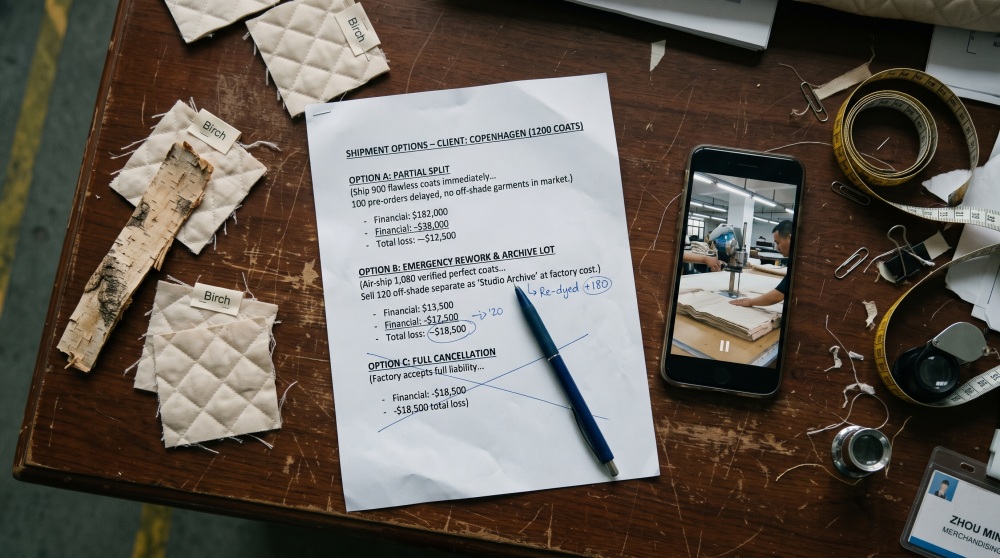
Attached to the email was a clear decision matrix with every financial variable laid bare:
| Option | Execution & Logistics | Commercial & Brand Impact |
| Option A: Partial Split | Ship 900 flawless original coats immediately. The remaining 300 held for standard re-dyeing in the next production cycle. | Pop-up flagship launches with 75% inventory. 100 pre-orders delayed by 25 days. Zero off-shade garments enter the market. |
| Option B: Emergency Rework & Archive Lot | Air-ship 1,080 verified perfect coats (900 original + 180 emergency recuts). The remaining 120 off-shade coats packed separately as ‘Studio Archive’ pieces at factory cost. | Fulfills 100% of pre-orders. Pop-up fully stocked. The 120 off-shade coats sold transparently as a unique studio archive at a reduced price point. |
| Option C: Full Cancellation | Factory accepts full liability, voids the contract, and refunds 100% of deposits via international wire within 24 hours. | Brand forfeits the fall season and cancels pop-up store. Factory absorbs fabric losses; client avoids financial outlay. |
At the bottom of the email, I typed a single concluding sentence:
“I will not make this choice for you. But I will never allow you to make a choice without seeing its true cost.”
Her reply arrived six hours later.
She chose Option B.
Below her formal confirmation, she wrote three sentences that remain etched in my memory:
“I spent the last three years assuming an overseas factory would always choose to conceal flaws—or worse, decide behind my back and let me discover the disaster at the retail door. You didn’t. It will take me a while to get used to having a real partner.”
That Afternoon
November 7th. Copenhagen.
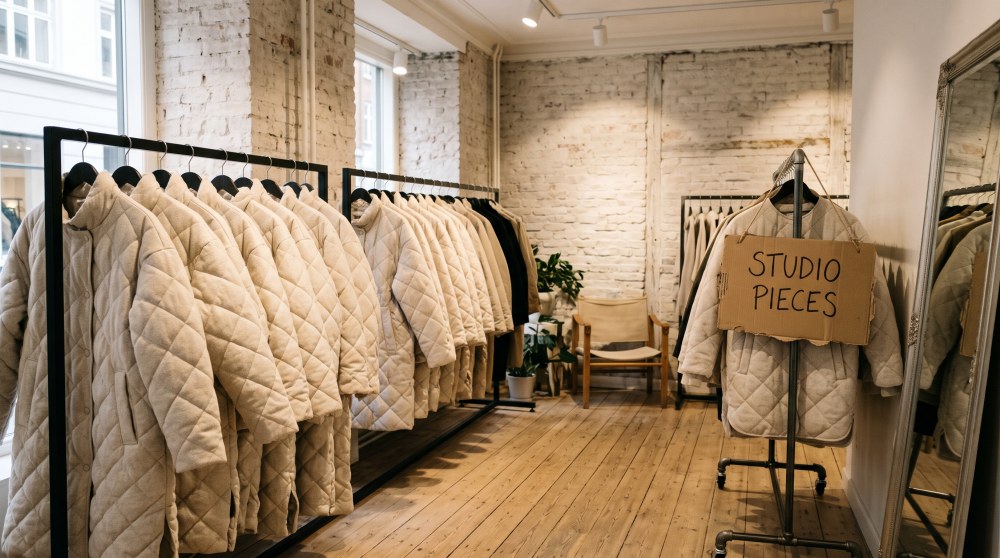
Her pop-up store was located on a narrow, cobblestone alleyway in the Latin Quarter, converted from an old mid-century barbershop. Plain whitewashed brick walls, raw pine floorboards, and a single black steel clothes rail, with the vintage salon mirrors still hanging in place.
At 3:00 PM Danish time, my phone chimed with a photo.
On the main rail hung the rows of quilted birch coats, catching the warm gallery spotlighting. Off in the corner stood a minimalist standalone rack holding the one hundred and twenty slightly deeper-hued coats. Hanging beside them was a handwritten piece of thick craft cardboard: Studio Archive Pieces.
I typed back: “Did anyone notice?”
She replied instantly: “The very first customer who walked in asked why the corner rack was priced twenty percent lower. I told her the truth: the dye vat ran half a shade deeper than my swatch. She tried it on, looked at herself in the vintage mirror, and smiled: ‘Then I’ll take this one.’ She told me the deeper tone looked richer against Danish winter rain.”
I stared at that photo for a long time.
I forwarded the image to Lao Chen. Late that night, he sent back a three-word text: “那就好” (That is good then).
In Yiwu, it was past 10:00 PM. Outside the window, the evening shift was still running, the distant flutter of sewing machines sounding like summer rain across a corrugated tin roof.
I pulled open my lower desk drawer. The strip of birch bark was still resting there, curled tight at the edges, its surface slightly darker than the day it landed from Denmark.
Afterwards
By the time Season Four rolled around, Elin’s technical packet arrived three weeks ahead of schedule.
In earlier years, I had to hound her for tech pack revisions; now, her files arrived complete with digital diagrams illustrating exact cardboard folding sequences for packaging.
She began seeking my technical and aesthetic input before issuing strike-offs. When evaluating lab dips, she would mail three variants to Yiwu first: “Min, which one do you think holds its character under commercial department store lighting?”
I told her: “Don’t ask me. Ask your customer base.”
She laughed: “I did. They said they’re all beautiful. That’s why I need your eyes.”
That was the moment our commercial dynamic fundamentally shifted. She no longer regarded us as an outsourced execution mill, and I no longer regarded her as an anxious foreign buyer liable to change specs at the eleventh hour.
That order also changed how I run my floor.
Ever since that November, before any cutting blade touches bulk fabric on any of my accounts, I institute one non-negotiable step: I lay the unrolled cloth across the inspection table under standard D65 daylight lamps, place the client’s approved golden master directly on top, and snap a high-resolution photograph.
I send it without long commentary. Not because I’m seeking bureaucratic sign-offs to dodge legal liability—but because I want them to see what I see.
Some clients write back: “Looks identical to the swatch!”
I always reply: “Exactly. That’s what I needed you to know.”
In March of this year, a courier package arrived from Copenhagen.
Inside was a finished sample from her new winter collection, accompanied by a small card. Written in her sloping handwriting were six words:
“Thank you for not shipping.”
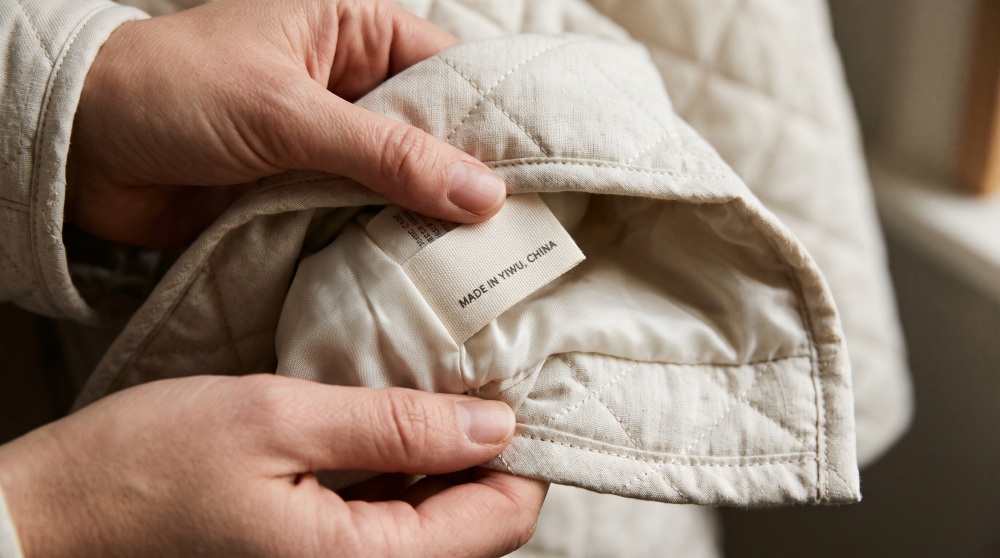
I flipped the coat open and looked at the woven care label sewn into the lower side seam.
In clean, embossed black letters, it read:
Made in Yiwu, China.
I sat in the empty sample room and touched those stitched letters for a long time.
Because I knew that three years ago, on her very first production run of three hundred coats, the care label carried only three words: Designed in Copenhagen.
Epilogue: The Two Coats
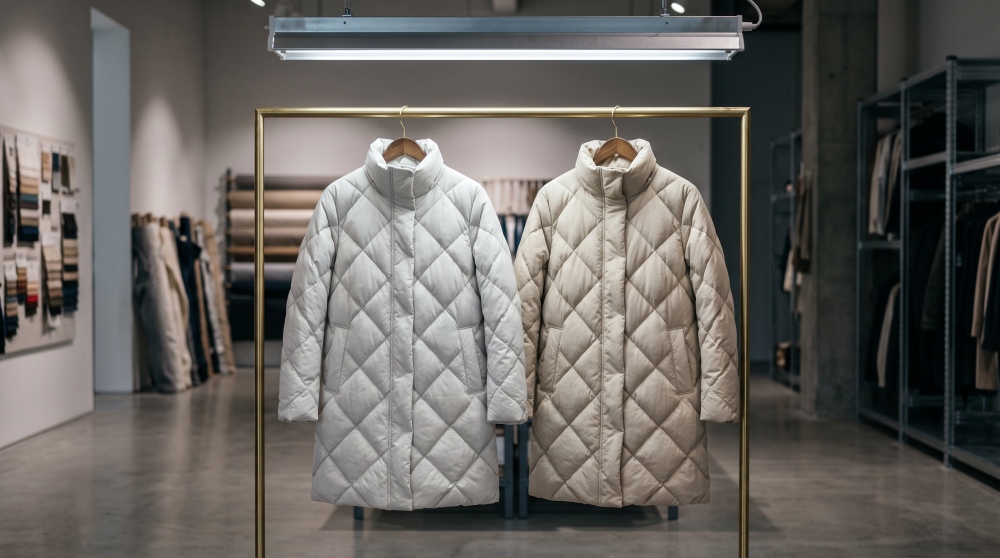
In our factory showroom, hanging side by side on a brass rail, are two quilted coats.
One is from Vat One: Birch in autumn frost.
One is from Vat Two: Birch under three days of hot summer sun.
When new overseas brand founders visit our facility to negotiate OEM contracts, I often lift both garments off the rack and ask: “Can you spot the difference between these two?”
Almost none of them can. They lean in, squint, rub the fabric between their fingertips, and shake their heads.
Then I walk them over to the inspection light box, switch on the D65 daylight bulbs, and lay the garments side by side.
The difference instantly reveals itself. One breathes cool; one breathes warm. Like two sisters standing in entirely different weather.
Then I tell them the story:
“This coat on the left, we shipped across the ocean. This coat on the right, we locked in a carton and held back.”
| “Real manufacturing partnership isn’t about quietly making choices behind a customer’s back to protect short-term margins. Real partnership is having the courage to show them the truth—and making sure they see what you see.”— Zhou Min, Merchandiser |
Appendix: Brand Narrative Strategy & Operational Guide
I. Multi-Channel Deployment Framework
This narrative is designed to transcend standard transactional marketing by positioning the manufacturing partner as an indispensable brand co-creator. Recommended deployment channels include:
• B2B Website / ‘About Us’ & Philosophy Page: Deploy the story as an editorial case study highlighting extreme quality control and ethical manufacturing practices, building immediate trust with tier-one international buyers.
• Founder Onboarding & Welcome Kit: Include a printed digest of this narrative in new client onboarding packets to establish transparent communication protocols from Day One.
• LinkedIn & B2B Thought Leadership: Serialize individual chapters (e.g., ‘Chapter 1: My Job Is Translation’ and ‘Chapter 6: I Gave the Decision Back to Her’) into high-engagement thought pieces on supply chain transparency.
• Physical Showroom Installation: Create a dedicated display featuring the actual two coats under calibrated D65 lighting, accompanied by the birch bark and the original tech pack, turning facility tours into an unforgettable tactile experience.
II. Narrative Architecture & Strategic Levers
The narrative derives its persuasive power from three structural design choices:
• The Merchandiser’s Agency: Moving the protagonist from a passive order-taker to an active risk-manager. Zhou Min represents the modern Chinese manufacturing professional—fluent in technical parameters, commercially savvy, and deeply protective of the client’s long-term brand equity.
• Radical Candor vs. Compliance: Rejecting the cliché that ‘the customer is always right.’ When compliance leads to brand catastrophe, professional resistance becomes the highest form of customer service.
• Dignity of the Production Floor: Grounding the drama in authentic workshop reality—Sister Wang’s swift seamstress pride, Lao Chen’s midnight cutting table, and the shared empathy of workers whose own children sell apparel online.
III. Technical Quality Footnotes & Standards
To preserve technical authenticity during client reviews, the underlying industrial standards referenced in the narrative include:
• AQL 2.5 (Acceptable Quality Limit): Standard ISO 2859-1 sampling plan for final random inspection. While a marginal shade variation across separate cartons can statistically slip past an AQL 2.5 lot audit, it fails end-consumer visual coherence in high-end retail.
• Grey Scale for Color Change (ISO 105-A02): Industrial metric rating color deviation from Grade 1 (severe) to Grade 5 (no change). Grade 4.0 is standard commercial tolerance; Grade 3.5 represents noticeable divergence under daylight conditions.
• Cupro Lining (Bemberg): Regenerated cellulose fiber known for moisture management, static prevention, and cool initial thermal touch, contrasting with synthetic polyester linings.
IV. Confidentiality & Ethical Safeguards
This document represents a composite narrative drawn from real frontline production workflows in Yiwu, Zhejiang. Specific client names, trademarked hues, and sensitive proprietary financial numbers have been modified to protect commercial privacy while preserving absolute operational truth.