Opening one’s own online clothing boutique or establishing a clothing brand in North America is an extremely exciting journey. Nowadays, startup brand founders and independent shop owners are always filled with various unique and creative ideas in their minds. You have keenly identified market gaps, possess excellent aesthetic vision, and are eager to make your customized brand stand out.
However, if you are a novice in the clothing industry, the process of turning a creative idea into a final ready to wear garment that can be pushed to the market may leave you somewhat at a loss. Many startup brands fall into pitfalls when dealing with app factories for the first time. People often underestimate the technical steps, actual costs, and production reality behind producing high-quality clothing.
At Wingtu, we are delighted to collaborate with passionate and creative entrepreneurs. But in order to help you succeed, we want to uncover the behind the scenes truth of the operation of professional clothing manufacturers for you. If you want to avoid expensive mistakes, save months of friction in communication, and establish a smooth partnership with your factory, this comprehensive guide will take you through everything you need to know about the Custom Clothing journey.

Refuse only one picture: What does the factory need to start production?
When facing a new brand, the most common scene we encounter is this: the customer sends several pictures cut from Pinterest or Instagram, and then says, “I want to make a long morning gown with the same appearance, but with my logo. Can you give me a quote and make a sample outfit? ”
As an experienced apparel factory, we fully understand the practice of using inspirational images to convey aesthetic style. However, based solely on one photo, manufacturers cannot make precise samples or calculate accurate production costs.
Why are inspirational pictures far from enough?
A photo leaves too many unanswered questions. It cannot reflect specific fabric composition, fabric weight (GSM), internal wiring details, pocket depth, or precise dimensions. If the factory only tries to make sample clothes based on guessing pictures, the final product will almost certainly differ greatly from your imagination in terms of texture or pattern, thus wasting time and money.
Professional solution: Tech Pack
In order to turn your creative ideas into tangible reality, you need to provide a Tech Pack or highly detailed design blueprint. You can understand Tech Pack as architectural construction drawings for clothing. A professional design layout should include:
Vector Flat Sketches: Clear line drawings that showcase the front, back, and side views of clothing (without the need for shadows or live models).
Bill of Materials: A detailed list that clearly outlines every component required, from the main fabric and lining to sewing thread, zipper, buttons, and wash marks.
Logo and brand specifications: high-resolution vector files (in AI or PDF format) indicating the specific location, size, and production process (such as embroidery or screen printing).
Complete size chart: Specific and detailed data for each measurement point (chest circumference, clothing length, sleeve length, etc.) customized for your target audience (such as standard North American sizes).
Providing these professional specifications can ensure that your factory can achieve your design vision 100% accurately from day one.
Unveiling the production of sample clothes: Why are sample clothes so expensive?
Another common misconception among start-up brands is about the cost of making samples (clothing samples). New buyers are often shocked when a factory quotes a sample fee of $100 to $250 for a single piece of clothing that may have a final retail price of only $40.
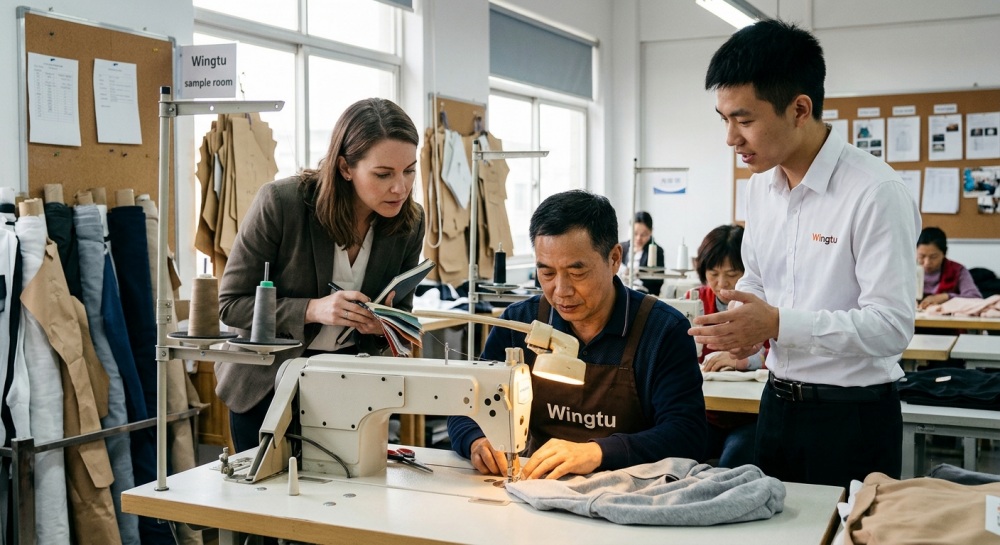
It is easy for people to think that the factory is charging arbitrarily, but creating a unique custom prototype garment requires a significant investment of high-tech labor and resource adjustments. When you pay for a sample garment, you are not only buying a piece of clothing, but also funding a micro engineering development project.
The direction of the cost of dismantling sample clothes
Pattern development and digitization: Before cutting the first piece of fabric, a senior pattern maker must create a new set of digital or physical pattern paper from scratch based on your design. This is a high-tech job that requires several hours of effort.
Machine debugging and programming costs: If your design includes custom embroidery, the digital designer must first convert your logo into a software program that the embroidery machine can recognize. Then, a large industrial embroidery machine that usually runs dozens of pieces of clothing at once must be shut down, re threaded with the specific color embroidery thread you specified, and calibrated – all just to run your sample garment.
Senior labor costs: In mass production on assembly lines, workers maintain high efficiency and low costs by repeating a single action. When making samples, experienced sample makers must independently manually cut and sew the entire garment, analyzing the structural integrity of each stitch step by step.
International courier fee: Sending an urgent single package from a factory in China to your doorstep in North America via international courier services such as DHL, FedEx, or UPS incurs high basic international logistics costs.
Sample making is an essential foundational investment in the early stages of brand establishment. Once your design is perfectly finalized, the pattern is locked, and the machine calibration is completed, these early development costs will disappear, resulting in a significant decrease in the unit price of your bulk production.
The bone feeling reality of minimum order quantity (MOQ): why is quantity so important?
For start-up brands, cash flow is life, so their instinctive reaction is to minimize inventory as much as possible. This leads to the most common question: “Can I start with an order of 20 or 50 pieces first
Although we fully understand the original intention of reducing risks, true custom clothing manufacturing must reach a basic quantity in order to be economically feasible. The minimum order quantity (MOQ) required by most professional clothing factories is usually at least 200 to 500 pieces per style, and many large industrial facilities do not even accept orders below 1000 pieces.
Why can’t small batch orders cover the cost logic of the factory?
Industrial textile manufacturing relies entirely on “economies of scale”. When a factory launches a customized series, the initial fixed sunk costs are very high:
Fabric weaving and dyeing minimum order quantity: Printing and dyeing factories and fabric factories do not retail fabrics to custom manufacturers by meter. They usually sell fabrics in whole pieces or rolls. If your order only requires 50 yards of a specific custom color fabric, but the minimum dyeing quantity for the fabric factory is 300 yards, then the remaining inventory fabric will become dead inventory waste, and someone must bear this cost.
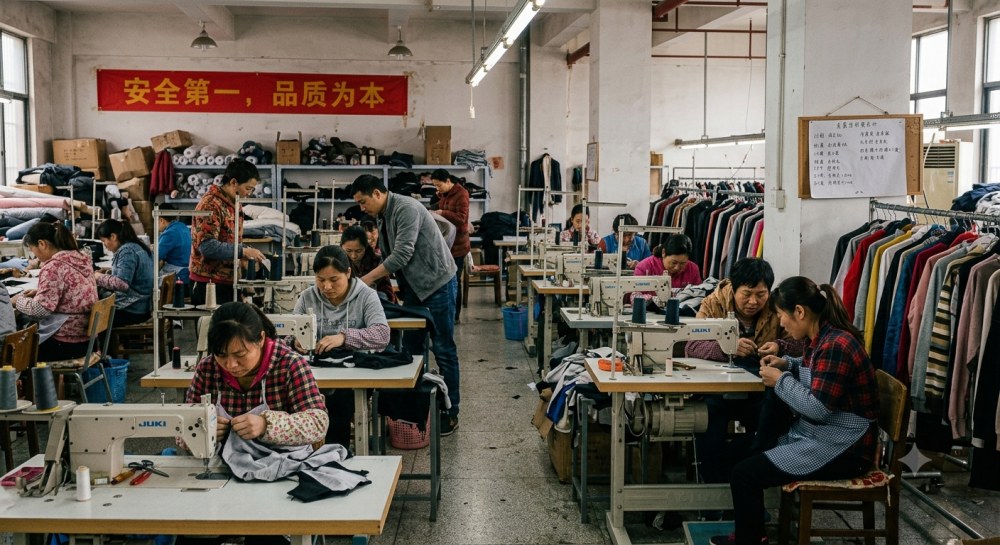
Machine shutdown loss: The factory’s profit comes from the continuous operation of the production line. Stopping the entire production line for a small order of only 30 pieces, switching sewing thread colors, changing sewing machine settings, and adjusting labels will completely destroy the factory’s production efficiency and lead to losses.
Smart strategies for start-up brands to cope with minimum order quantities
If your initial budget does not support excessive investment, you don’t actually need to compromise on brand characteristics. You can cleverly maneuver under the factory’s rules:
Simplify your styles: Instead of launching 5 different designs with 50 pieces each, it’s better to select 1 to 2 core products with excellent designs and make 200 pieces of each.
Shared fabrics and colors: If you are launching a home wear collection, you can have a custom morning gown and a matching nightgown use exactly the same fabric and color. This way, the factory can purchase a larger quantity of the same fabric at once, helping you easily meet the minimum order quantity threshold for raw materials in the fabric factory.
Essential supplements for novice technical kits: size standards and production cycles
In addition to the process technology package, sample clothing, and minimum order quantity, there are two blind spots that often make new players in North American clothing fall into: size differences and miscalculation of time spans.
Avoid the trap of “Western sizing”
The size standards vary greatly around the world. The term ‘Asian L code’ commonly used by domestic factories often only corresponds to ‘North American S code’ or ‘M code’. If you simply tell the Chinese factory to make an “M size” without providing an accurate size chart that includes specific inches or centimeters, the resulting clothes are likely to be too small for your local customers in North America to wear. Please make sure to clearly define the precise template data you want in the technical documentation.
Accurately calculate the manufacturing cycle of clothing in reality
In the era of fast logistics retail, it is easy for people to forget that building a clothing brand from scratch requires a long process of industry and craftsmanship. A reasonable customized manufacturing cycle is usually as follows:
Design and process technology package docking communication: 1 to 2 weeks
Sample garment production, mailing, and modification confirmation: 2 to 4 weeks (including international shipping time)
Fabric procurement, dyeing, and preparation: 3 to 4 weeks
Bulk cutting, sewing, and full inspection: 4 to 6 weeks
Logistics transportation and customs clearance: Air transportation takes about 1 week, while sea transportation takes 4 to 6 weeks
If you want to launch a new winter Christmas product at the end of November, you absolutely cannot wait until September to start negotiating with the factory. Successful brands typically start planning their supply chain at least 4 to 6 months in advance to allow sufficient time to deal with possible fabric delays, holiday closures, and customs clearance.
Conclusion: Transform your creative vision into sustainable business success
Creating your own private label clothing brand is a very fulfilling thing, but it requires a mindset shift from being an “ordinary consumer” to a “professional supply chain manager”.
Factories are not stumbling blocks on your creative path, but industrial partners who anchor your artistic creativity in the real world. Willing to spend time preparing a clear and standardized technical design blueprint, understanding that sample clothing costs are essential product development investments, and learning to intelligently plan order volumes to match factory operational efficiency – by doing these points well, you can instantly surpass 90% of amateur players.
When you learn to communicate in the language of the factory, you can reduce errors, lower long-term costs, and create world-class high-quality products that are constantly repurchased by online store customers.
Are you ready to work with reliable production partners to elevate your online store to new heights? At Wingtu, we are committed to using high-quality fabrics, smooth communication, and professional design guidance to help independent brands achieve seamless scaling. Contact our supply chain team immediately to share your design concept and obtain our latest fabric sample booklet.