A Quote Is a Stack of Decisions, Not a Number
A quote is not one number. It is a stack of decisions you already made — fabric weight, stitch density, trims, packaging, quantity — except you probably did not realize you were making them. Two factories can quote the same total and be selling completely different things. If you only read the bottom line, you will pick the wrong supplier and find out after the deposit is gone.
This is written for brand owners and sourcing managers who need to read a garment quote line by line and compare two quotes on equal terms.
The Four Layers of an Apparel Quote
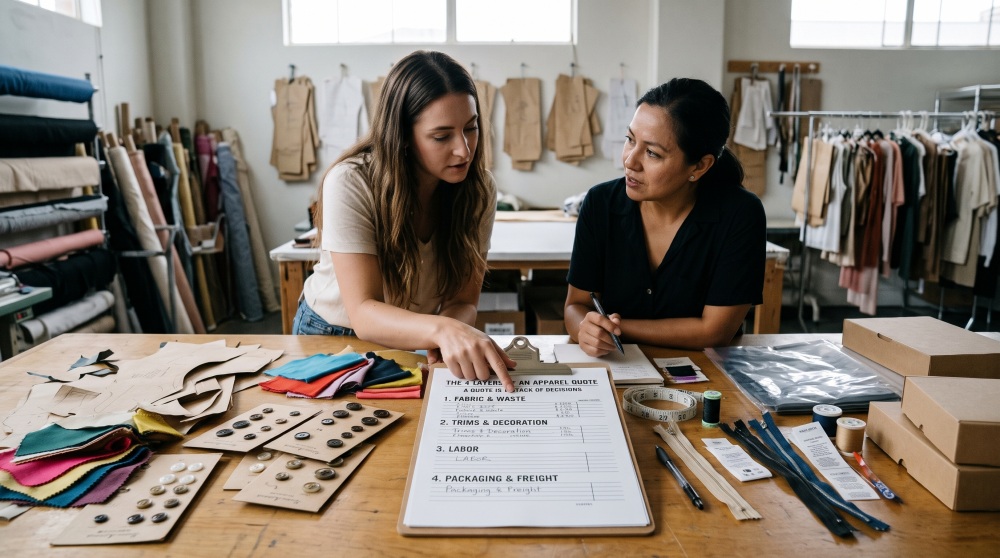
Every finished-garment quote breaks into four layers. Skip any one of them and the total means nothing.
Fabric and cutting waste. Fabric usually runs 40–60% of finished garment cost. The quote depends on weight, composition, width, and how efficiently the pattern lays out on the marker. Heavier fabric and a poorer layout both cost more. Cutting waste is real, not a rounding error — knits run 5–10%, and stripes or checks cost more again.
Trims and decoration. Labels, zippers, buttons, drawcords, hangtags, embroidery, print. Each one is its own line, each one has its own MOQ and setup fee. This is where “the quote looked fine” turns into an unexpected invoice.
Labor. Cutting, sewing, finishing. Labor rises with process complexity: more seams and more operations mean more minutes per garment. A basic tee takes roughly 5–7 minutes to sew; a lined jacket with flap pockets is a different order of magnitude.
Packaging and freight. Polybags, inner boxes, export cartons, and the trade term — FOB, EXW, or DDP. A quote with no trade term is not a finished quote.
Per-Unit Cost vs One-Time Cost
The fastest way to misread a quote is to blur these two categories.
| Cost item | Type | When it hits | What drives it |
|---|---|---|---|
| Fabric (knit / woven) | Per unit | Every order | Panel area, weight, layout efficiency, waste |
| Dyeing / dye lot | One-time per colorway | First order, per color | Fabric type, color standard |
| Trims (labels, zippers, buttons) | Per unit | Every order | Spec, quantity, trim MOQ |
| Decoration (embroidery, print) | One-time + per unit | Setup once, then per piece | Artwork, number of colors, placement |
| Cutting and sewing labor | Per unit | Every order | Processes, seam count |
| Sampling | One-time | First order | Complexity, revision rounds |
| Lab dip / color matching | One-time | First order, per color | Fabric, color standard |
| Pattern / grading | One-time | First order | Size range, block complexity |
| Packaging | Per unit | Every order | Hangtag, polybag, box |
| Freight | Per shipment | Every shipment | Volume, weight, trade term |
One-time costs hit small orders hardest. A $300 pattern fee spread over 5,000 units is nothing; spread over 300 units, you have added a dollar per garment before sewing a single stitch.
Where Quantity Changes the Math
Volume lowers unit cost, but unevenly. Fabric drops in tonnage tiers — 100 kg, 500 kg, 1,000 kg. Labor falls as lines speed up and setup spreads thinner. Trims drop once you clear their MOQ threshold.
What quantity does not change: pattern fees, lab dip fees, and the dye lot per color. Those are fixed. If a supplier quotes the same fabric price at 300 units and at 3,000 units, they either did not cost it or they are pricing the small run up.
How to Compare Two Quotes Correctly
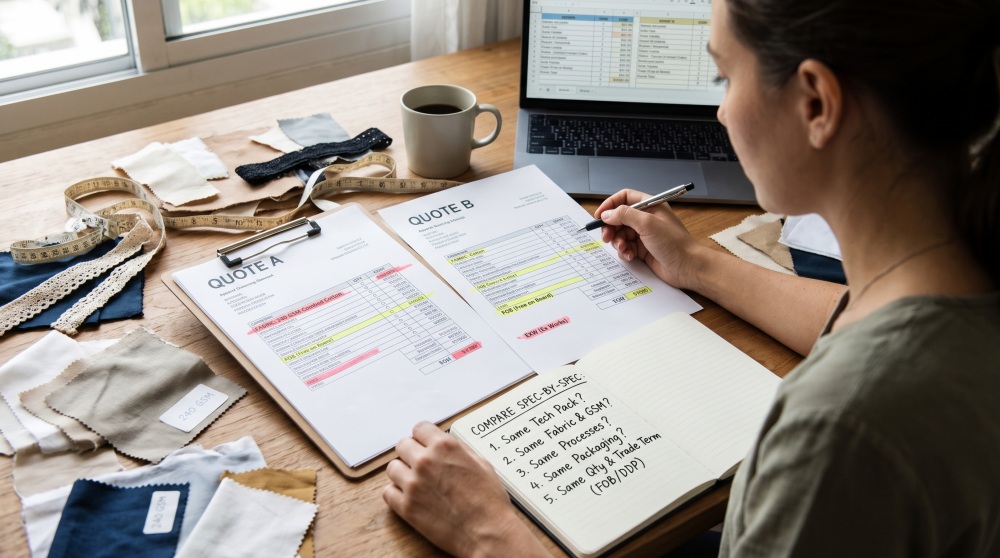
Two totals only mean something when the spec underneath them matches. Before comparing, lock:
- The same tech pack. Same measurements, same grading rules, same seam types.
- The same fabric. Same composition, weight, and width — not “cotton,” but “240 GSM combed cotton knit, 180 cm width.”
- The same processes. Same operation count, same finishing.
- The same packaging. Same polybag, hangtag, carton spec.
- The same quantity tier and trade term. A quote for 500 units FOB cannot be compared against a quote for 1,000 units DDP.
Then compare line by line, not total to total. The gap usually hides in fabric weight, the trade term, or a setup fee that was left out.
What Suppliers Quietly Leave Out
- Pattern and grading fees. Often written as “not included,” then added after you approve the sample.
- Lab dip. Quotes assume your color matches stock; custom colors are charged separately.
- Packaging spec. No hangtag, no polybag, no box — or all of them in the cheapest version available.
- Trade term. A bare price with neither FOB, EXW, nor DDP is a hole, not a saving.
- Quote validity. No expiry date means the price can change tomorrow.
- MOQ breakdown. A total minimum with no style or colorway split hides the real terms.
Before you pay anything, get a written quote with a line item for every one of these. If a supplier will not break it down, that is the answer.
A Straight Answer
Wingtu Apparel is one of many options. We do full-category custom apparel — tees, hoodies, pants, outerwear, shirts, polos, knitwear, denim, and loungewear — and we quote it line by line: fabric, trims, labor, setup, packaging, freight, so you can compare us against anyone on equal terms. We are not the factory that takes rigid or non-apparel projects. If your line is apparel, send your spec and we will break the cost down with you.
FAQ
Q: Why do two factories quote different prices for the same garment?
A: Usually because the spec underneath differs — fabric weight, processes, packaging, or the trade term. Compare the line items, not the total.
Q: What should a proper apparel quote include?
A: At minimum: fabric (with composition and weight), trims, labor, any setup or sampling charges, packaging, trade term, and quantity tier. Whatever is missing comes back later on the invoice.
Q: How do I lower the cost of my order?
A: Raise the quantity, use stock fabric, cut the number of colorways, simplify the construction, and combine markers across styles. Fixed fees like pattern and lab dip do not move with volume.
Q: Is the lowest quote the best quote?
A: No. A low total that omits setup, packaging, or freight costs more at the end. A lower fabric weight is a different, cheaper product — not a saving.
CTA
Send us your tech pack or a rough brief, and we will quote it line by line so you can see exactly where the money goes.
Get a Quote